
Why stableswap needs AI now
Traditional automated market makers (AMMs) rely on static mathematical curves, such as the constant product formula, to determine asset prices. While effective for volatile assets, these rigid models struggle with stablecoin pairs where prices should remain pegged. When market pressure pushes a token slightly off-peg, a static curve often fails to provide sufficient liquidity, resulting in high slippage for traders seeking to swap similar-asset pairs.
StableSwap addresses this by introducing a hybrid invariant that blends the efficiency of constant product models with the stability of constant sum models. This design ensures that trades near the peg incur minimal fees and slippage, while larger deviations trigger a gradual shift toward the constant product behavior to prevent arbitrage exploitation. However, this static approach still assumes that market conditions remain predictable, which rarely happens in live trading environments.
AI-driven liquidity management transforms this static framework into a dynamic system. By analyzing real-time order flow, volatility spikes, and cross-market correlations, AI algorithms can adjust the pool’s invariant parameters on the fly. This allows the protocol to anticipate large trades and adjust liquidity depth accordingly, effectively flattening the slippage curve for users.
The result is a more resilient liquidity layer that adapts to market stress rather than breaking under it. For traders, this means tighter spreads and better execution prices, even during periods of high volatility. As stablecoin adoption grows, the integration of AI into stableswap mechanics becomes essential for maintaining the low-slippage environment that defines these pools.
Curve StableSwap NG deployment
Curve Finance has shifted its core infrastructure to StableSwap NG, an open-source Automatic Market Maker (AMM) designed to handle larger pools with minimal slippage. Unlike earlier iterations, this deployment is permissionless, allowing developers to launch pools directly on-chain without waiting for protocol governance approval. This shift accelerates the integration of new stablecoin pairs and reduces the friction typically associated with adding liquidity venues.
The architecture supports up to eight coins in plain pools, a significant upgrade from the traditional two-coin limit. This multi-asset capability allows for more complex liquidity routing, such as balancing three or four different stablecoins in a single pool. Metapools remain limited to two coins but serve as a bridge to the broader ecosystem, connecting specific assets to the main liquidity depth.
For developers, the codebase is available on GitHub, offering transparency and the ability to customize pool parameters within the protocol's bounds. The implementation retains the core StableSwap invariant that minimizes price impact for stable assets while introducing optimizations for gas efficiency and cross-chain compatibility.
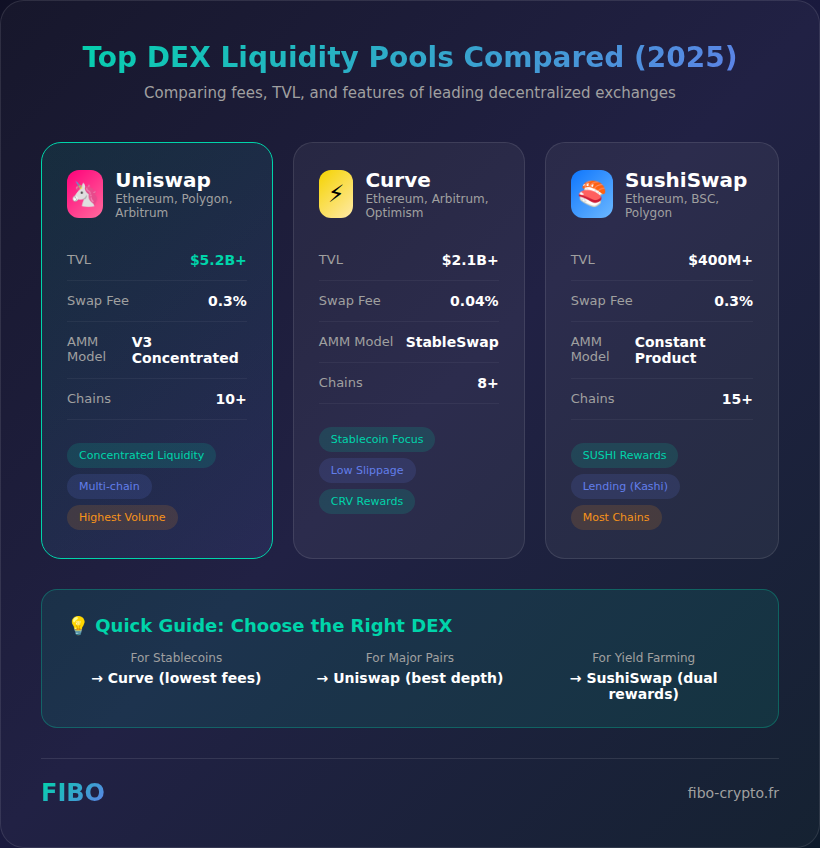
The move to StableSwap NG represents a structural update rather than a new protocol. It preserves the low-fee, high-liquidity environment that defined Curve’s original success while expanding the technical ceiling for what a single pool can hold. This flexibility is essential for an AI-optimized stableswap strategy, where capital efficiency depends on accessing the deepest available liquidity across multiple asset types.
AI-driven stability mechanisms
AI models now predict volatility and adjust pool parameters in real-time to maintain peg stability. Unlike static algorithms, these systems monitor on-chain liquidity depth, order book imbalances, and broader market sentiment to anticipate slippage before it occurs. This proactive approach keeps stablecoins anchored even during periods of extreme market stress.
The convergence of AI and stablecoins is creating smarter financial systems, automating processes with tools like real-time smart contracts to react to liquidity shocks instantly. By continuously recalibrating fees and liquidity incentives, AI-driven pools can absorb large trades without significant price deviation.
This dynamic adjustment process relies on complex machine learning models trained on historical trading data and real-time oracle feeds. These models identify subtle patterns that human traders or static scripts might miss, allowing for more precise interventions. As a result, stableswap pools powered by AI offer a more resilient trading environment, reducing the risk of de-pegging events that have plagued algorithmic stablecoins in the past.
Top 5 AI-optimized stableswap pools
AI-driven optimization adjusts liquidity allocation and fee structures in real time, reducing the price impact you feel when trading. These five stableswap pools demonstrate how algorithmic management keeps slippage low while capturing yield that static pools miss.
Top 5 AI-optimized stableswap pools
-
Curve Finance (v3)
Curve uses an AI-like virtual market maker to optimize liquidity density across its pool variants. The v3 upgrade introduced dynamic fees, allowing the protocol to adjust spread costs based on real-time volatility, making it the benchmark for low-slippage stablecoin swaps. -
Convex Finance
Convex sits on top of Curve, acting as a yield booster. It aggregates deposits to maximize CRV token rewards and reduces the gas costs for liquidity providers. The platform handles the complex voting and incentive distribution, offering higher yields than direct Curve participation. -
Balancer (Smart Pools)
Balancer allows for multi-asset pools with customizable weights. Its AI-optimized rebalancing features automatically adjust asset ratios to maintain target allocations, reducing the need for manual intervention and capturing rebalancing alpha while maintaining low trading fees. -
Uniswap V3 (Stable Pairs)
While not a pure stableswap, Uniswap V3’s concentrated liquidity model allows for precise capital efficiency. When applied to stable pairs, it offers tight spreads similar to stableswaps. AI tools now help LPs select optimal tick ranges to minimize impermanent loss and maximize fee capture. -
StableSwap by Solana
Built for high throughput, this pool leverages Solana’s speed to execute complex arbitrage and rebalancing algorithms instantly. The low transaction costs allow for finer granularity in liquidity provision, resulting in tighter spreads for USDC and USDT pairs.
The difference between these pools lies in their approach to risk and reward. Curve and Convex prioritize capital preservation with steady yields, while Balancer and Uniswap offer higher potential returns through active management. Solana’s ecosystem provides the infrastructure for rapid, low-cost execution. Choosing the right pool depends on your tolerance for active management versus passive holding.
Security and Smart Contract Risks in AI Pools
AI-optimized StableSwap pools promise precision, but they introduce complex dependencies that traditional liquidity pools do not. The core risk lies in the interaction between the automated market maker (AMM) logic and the AI layer that adjusts parameters in real-time. If the AI model malfunctions or is exploited, it can trigger cascading failures within the pool, leading to significant financial loss for liquidity providers.
One critical vulnerability is the reliance on external data feeds. AI models often require real-time market data to make optimization decisions. If these data sources are manipulated or delayed, the pool’s pricing mechanism can drift, creating arbitrage opportunities that drain funds. This is particularly dangerous in high-stakes environments where slippage is minimized, and margins are thin. A single point of failure in the data pipeline can compromise the entire pool’s integrity.
Another concern is the opacity of AI-driven strategies. Unlike traditional algorithms that follow deterministic rules, AI models can behave unpredictably under stress. This lack of transparency makes it difficult for auditors to verify the safety of the smart contract before deployment. Users must rely on the project’s internal security practices and external audit reports to assess risk.
To mitigate these risks, it is essential to verify the security credentials of any AI-optimized pool. Look for projects that have undergone rigorous smart contract audits from reputable firms. Additionally, consider the track record of the development team and their responsiveness to security incidents. Always check official sources and community forums for any reported vulnerabilities or exploits.
Finally, be aware of the potential for centralization risks. Some AI-optimized pools may rely on centralized oracles or governance mechanisms that can be manipulated. Ensure that the pool’s design includes safeguards against such centralization, such as decentralized oracle networks or multi-signature governance structures. By understanding these risks, you can make more informed decisions when participating in AI-optimized DeFi pools.
No comments yet. Be the first to share your thoughts!