
StableSwap Hub implementations and specialized stableswap aggregators are essential for minimizing slippage and impermanent loss when trading pegged assets, as standard AMM invariants fail to account for the tight price correlation of stablecoins.
Standard automated market maker (AMM) logic, while elegant for volatile assets, fails when applied to pegged tokens. When trading assets like USDC against USDT, the price remains tightly bound to a 1:1 ratio. In a traditional Constant Product Market Maker (CPMM) model, this lack of volatility triggers the "impermanent loss" mechanism aggressively, causing the pool to rebalance constantly and drive up trading costs for users. The result is high slippage and inflated fees for trades that should be frictionless.
StableSwap Hub implementations solve this by introducing a modified invariant, as detailed in Curve’s official documentation. This algorithm blends the behaviors of a CPMM and a Constant Sum Market Maker. For small deviations from the peg, the pool operates with near-zero slippage, similar to a constant sum model. As the deviation grows, it gradually transitions toward CPMM behavior, protecting liquidity providers from severe impermanent loss. This hybrid approach ensures that high-volume stablecoin trading remains efficient and cost-effective.
Aggregators that rely solely on standard AMM routing often miss this nuance. They may route stablecoin trades through generic liquidity pools where the spread widens unnecessarily. By prioritizing StableSwap Hub pools, traders benefit from the tightest possible spreads, a critical advantage in a market where margins are thin and volume is high. The specialized routing is not just a feature; it is the foundation of reliable stablecoin liquidity.
How StableSwap Hub Mechanics Differ from Aggregators
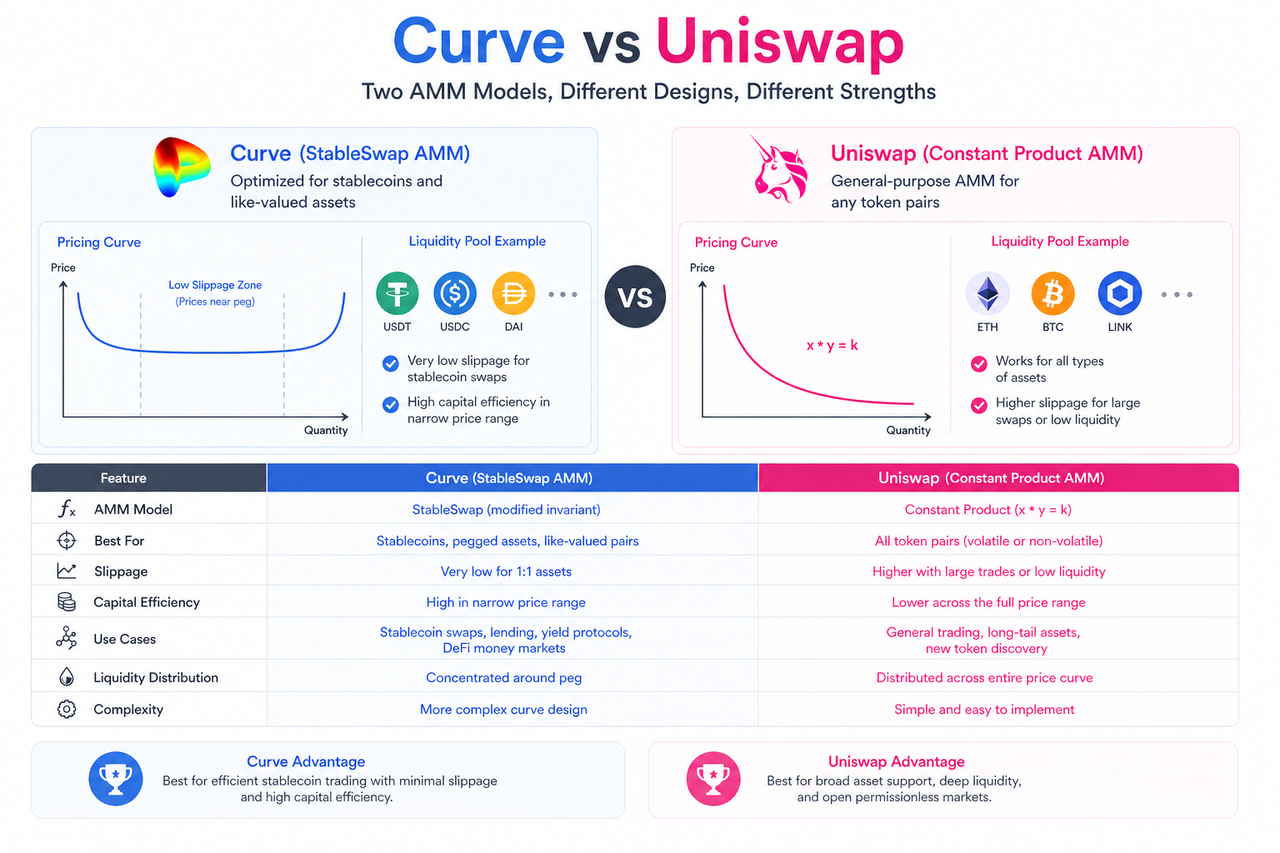
The technical advantage of StableSwap Hub lies in its use of a specific invariant curve, distinct from the generic constant product formulas ($x \cdot y = k$) used by standard DEX aggregators. Aggregators like 1inch or Matcha simply route orders through existing Uniswap V2 or V3 pools. They do not change the underlying math; they only find the best path across multiple pools. StableSwap Hub, however, employs a custom algorithm designed specifically for assets pegged to the same value, such as stablecoins or wrapped Bitcoin.
The StableSwap invariant behaves like a constant sum (linear) near parity, where trades incur minimal slippage. As assets deviate from their peg, the curve transitions to behave like a constant product (hyperbolic), protecting the pool from impermanent loss. This hybrid approach means that for pairs like USDC/DAI or USDT/USDC, the hub offers capital efficiency that generic AMMs cannot match. A $100,000 trade might see less than 0.01% slippage in a StableSwap pool, whereas the same trade in a standard Uniswap V3 pool could cost significantly more due to wider fee tiers and deeper liquidity requirements.
This mechanical difference is critical for high-volume stablecoin rotations. Aggregators are best for directional bets or volatile assets where deep liquidity is fragmented. For stablecoin swaps, the StableSwap Hub’s dedicated liquidity pools provide a smoother execution curve. The following table compares the operational metrics of these two approaches.
| Feature | StableSwap Hub | DEX Aggregators |
|---|---|---|
| Invariant Model | Hybrid (Constant Sum/Product) | Constant Product (V2) or Concentrated (V3) |
| Slippage (Stable Pairs) | < 0.01% | 0.05% - 0.3% |
| Capital Efficiency | High (Linear near parity) | Low (Requires deep liquidity) |
| Best Use Case | Stablecoin swaps, arbitrage | Volatile assets, large cross-asset swaps |
The choice between these systems depends on the asset class. If you are swapping USDC for DAI, the StableSwap Hub’s invariant minimizes cost. If you are swapping ETH for USDC, an aggregator’s ability to split orders across multiple liquidity tiers often yields a better price. Understanding this distinction prevents unnecessary slippage on stable assets.
Why liquidity providers favor stablecoin pools
Liquidity providers (LPs) entering the DeFi space often face a significant barrier: impermanent loss (IL). In standard constant product markets like those found on Uniswap or PancakeSwap’s default pools, price divergence between assets erodes capital value. When one token appreciates relative to the other, the automated market maker sells the appreciating asset and buys the depreciating one, leaving the LP with a portfolio worth less than if they had simply held the assets. This mechanic makes standard AMMs risky for stablecoins, where traders expect minimal price fluctuation.
StableSwap Hub addresses this by employing a specialized invariant that blends the features of a constant product market maker and a stable swap mechanism. As detailed in Curve’s official documentation, the StableSwap algorithm is designed specifically for assets pegged to the same value. It maintains high liquidity and low slippage when assets are near their peg, while still allowing for efficient price discovery when they diverge. This mathematical structure significantly dampens the impermanent loss that typically plagues LPs in volatile environments.
The practical impact is substantial. In a StableSwap Hub pool, as long as the paired stablecoins remain close to their peg, the impermanent loss is negligible, often registering below 0.1%. This stands in stark contrast to standard AMMs, where even minor price movements can trigger noticeable IL. For high-stakes financial decisions, this stability transforms LPing from a speculative gamble into a predictable yield strategy. LPs can provide capital with confidence, knowing that the pool’s design protects their principal against the typical risks of automated trading.
When aggregators still beat specialized pools
StableSwap Hub is not a silver bullet. While its invariant curve minimizes slippage for pegged assets, specialized pools are siloed. They excel within their ecosystem but fail when liquidity is fragmented or when you need to move value across disparate chains. Aggregators like 1inch or Matcha solve this by routing trades across multiple venues, ensuring you get the best price regardless of where the liquidity lives.
The primary advantage of aggregators is cross-chain capability. StableSwap Hub operates on specific chains. If your stablecoins are on Ethereum and you need to swap on Arbitrum, you cannot use the hub directly. You must bridge first, incurring gas fees and time delays. Aggregators often integrate bridge protocols or rely on cross-chain DEXs, allowing a single transaction to settle across networks without manual intervention.
Exotic pairs also favor aggregation. StableSwap Hub is designed for assets with a stable peg (like USDC to USDT). It does not support volatile pairs or complex synthetic assets. If you are trading a stablecoin against a volatile token, or moving between two stablecoins that have no direct pool on the hub, an aggregator will find the optimal path through multiple DEXs. This prevents the high slippage you would face trying to force a trade through a single, illiquid pool.
Fragmented liquidity further limits the hub’s utility. In 2026, stablecoin liquidity is spread across dozens of chains and protocols. A single pool on StableSwap Hub may only hold a fraction of the total available liquidity for a given pair. Aggregators scan the entire market depth, splitting large orders across multiple sources to minimize price impact. For high-stakes financial decisions, this depth is often more valuable than the marginal slippage savings of a specialized pool.
2026 trends in stablecoin liquidity infrastructure
The stablecoin market is undergoing a structural shift. As institutional and retail volumes consolidate, high-liquidity StableSwap Hub implementations are becoming the default infrastructure for low-volatility trading. This move away from fragmented DEX aggregators is driven by the mathematical efficiency of the StableSwap invariant, which prioritizes capital preservation over speculative yield.
StableSwap pools utilize a hybrid AMM curve that operates like a Constant Product Maker (CPMM) for large trades but transitions to a Constant Sum Model for small deviations. This mechanism drastically reduces slippage for large orders and minimizes Impermanent Loss (IL) for liquidity providers. Unlike traditional DEXs, where liquidity is often fragmented across multiple pairs, StableSwap Hubs concentrate liquidity into single, deep pools for major pairs like USDC/USDT or DAI/USDC.
The trend is evident in recent deployments. StableChain, for instance, has integrated StableSwap as an official Uniswap V3 deployment, signaling a broader industry move toward specialized liquidity layers. This consolidation allows traders to execute large transactions with minimal price impact, a requirement that generic aggregators often fail to meet efficiently.
As the market matures, the distinction between trading venues will blur. The focus is shifting from finding the "best" price across multiple platforms to accessing deep, unified liquidity. For high-stakes financial decisions, this means relying on infrastructure that has been stress-tested for stability, not just yield.
Stableswap hub vs aggregators: common: what to check next
Understanding the mechanics of StableSwap Hub requires looking past the marketing and into the invariant itself. Unlike aggregators that route trades across fragmented liquidity, StableSwap Hub uses a single, optimized pool structure to minimize slippage on stablecoin swaps. This distinction is critical for high-frequency trading and treasury management where consistency matters more than absolute best-case pricing in thin markets.
No comments yet. Be the first to share your thoughts!