
Why stableswap liquidity 2026 matters
The landscape of digital asset liquidity has shifted from speculative volatility to institutional-grade infrastructure. In 2026, the focus is no longer on hype but on market structure, secondary liquidity, and the integration of Real World Assets (RWA). This transition defines why stableswap pools are now the backbone of efficient capital deployment rather than just a venue for arbitrage.
Stablecoins remain the primary vehicle for minimizing volatility in crypto markets, typically backed by cash or highly liquid money market funds. However, the depth of these pools determines their utility for large-scale transactions. Slippage and audit status have become the critical metrics for institutional adoption, replacing yield farming incentives as the primary driver for liquidity provision.
To understand the current state of the market, we must look at the underlying asset performance. The following chart illustrates the trend in stablecoin liquidity depth, grounding the current institutional shift in concrete market data.
This structural shift prioritizes protocols that offer transparency and robust security. As RWA tokens enter the stableswap ecosystem, the demand for low-latency, high-fidelity swaps increases. The following comparison highlights the leading protocols based on these institutional criteria.
Top stableswap pools for RWA tokenization
Institutional capital prefers protocols with deep liquidity and proven stability. For RWA tokenization and stablecoin swaps, Curve, Aerodrome, and Uniswap v4 dominate the market. These platforms offer distinct advantages depending on whether the priority is minimal slippage, yield generation, or composability.
Curve Finance remains the standard for stablecoin swaps. Its concentrated liquidity model and low fees make it the most efficient venue for large-volume trades. Aerodrome offers higher yields through ve(3,3) mechanics, attracting liquidity providers seeking enhanced returns. Uniswap v4 provides customizable hooks, allowing for specialized RWA pair configurations that traditional AMMs cannot support.
The following table compares these protocols based on Total Value Locked (TVL), estimated slippage for a $10,000 swap, and primary asset support.
| Protocol | TVL (Est.) | Slippage ($10k) | Primary Pairs |
|---|---|---|---|
| Curve Finance | $3.8B | < 0.05% | USDC/USDT, RWA-indexed |
| Aerodrome | $1.2B | 0.08% | USDC/AERO, USDT/USDC |
| Uniswap v4 | $2.5B | 0.12% | Custom RWA hooks, USDC/ETH |
Curve’s dominance in TVL reflects its role as the primary settlement layer for stablecoins. Aerodrome’s lower TVL is offset by higher yield incentives for liquidity providers. Uniswap v4’s flexibility allows for tailored RWA solutions, though its slippage rates remain slightly higher due to less concentrated liquidity in specific pairs.
For institutional traders, Curve offers the most predictable execution. Aerodrome suits those prioritizing yield over minimal slippage. Uniswap v4 is ideal for custom RWA structures requiring specialized logic.
Cross-chain stablecoin swap strategies
Liquidity for real-world assets and stablecoins is fragmented across distinct blockchain environments. Users attempting to move value between chains face bridge risks and significant slippage. Native stableswap mechanisms mitigate these issues by maintaining deep, correlated liquidity pools rather than relying on external bridge transfers for every trade.
Bridge exploits remain a primary vector for capital loss. Wrapping assets for cross-chain movement introduces smart contract complexity and custodial risk. Native liquidity protocols reduce this exposure by allowing swaps within a single chain’s ecosystem, often using solvers or atomic swaps to settle finality. This approach prioritizes capital preservation over convenience.
Protocol selection depends on TVL, audit status, and slippage metrics. The following table compares major cross-chain liquidity providers based on 2026 performance data.
| Protocol | TVL (USD) | Avg Slippage | Audit Status |
|---|---|---|---|
| Stargate | $320M | < 0.05% | Audited |
| Hop Protocol | $180M | < 0.08% | Audited |
| Across Protocol | $95M | < 0.06% | Audited |
DeFi yield strategies for 2026
Institutional capital flows into stableswap pools have shifted from speculative farming to structural yield generation. The primary objective for 2026 LPs is capital preservation through low-volatility pairs, leveraging the depth of Real-World Assets (RWA) and established stablecoin markets. Unlike high-risk meme coin farming, which relies on impermanent loss and volatile incentives, RWA-backed strategies offer yields anchored in traditional finance cash flows.
To evaluate these opportunities, LPs should assess audit status, TVL depth, fee tiers, and RWA issuer reputation before deploying capital.
-
Verify smart contract audit history and bug bounty status
-
Confirm TVL depth exceeds $50 million for low slippage
-
Check fee tier structure against current APY projections
-
Assess RWA issuer regulatory compliance and collateral quality
Protocol Selection Metrics
Selecting the right protocol requires comparing efficiency and security profiles. Curve Finance remains the benchmark for stablecoin swaps due to its concentrated liquidity model, while Uniswap v4 and Aerodrome offer modular approaches for specialized RWA pairs. The table below outlines the key distinctions between leading platforms for institutional LPs.
| Protocol | Primary Focus | Risk Profile | Audit Status |
|---|---|---|---|
| Curve Finance | Stablecoin & Pegged Assets | Low | Extensive (Multi-year) |
| Uniswap v4 | Modular RWA Pairs | Medium | Standard (Core + Hooks) |
| Aerodrome | Base Chain Liquidity | Medium | Regular (Bi-annual) |
Risk Management in Stableswap Pools
Impermanent loss is negligible in stableswap pools due to the correlated nature of the assets. However, smart contract risk and depegging events remain the primary threats. LPs should prioritize pools with deep reserves to absorb large trades without significant slippage. Additionally, monitoring the underlying RWA issuer's financial health is critical, as the yield is often derived from the performance of the real-world asset backing the token.
Monitoring and Rebalancing
Yield strategies require active monitoring. While stableswap pools are less volatile than volatile pairs, fee revenue can fluctuate with market conditions. LPs should rebalance their positions quarterly or when fee APY drops below 5%. Using on-chain analytics tools to track TVL trends and trading volume can help identify optimal entry and exit points for liquidity provision.
Frequently asked questions about stableswap liquidity
Are stablecoins highly liquid in 2026?
Stablecoins remain the most liquid cryptoassets, but liquidity is concentrated in specific pools. Major protocols like Curve and Uniswap v4 lead in depth, ensuring minimal slippage for large trades. However, liquidity depth varies significantly by pair; major USDC/USDT pools offer institutional-grade efficiency, while smaller RWA-backed pairs may experience wider spreads during market stress.
How do I add liquidity to a stableswap pool?
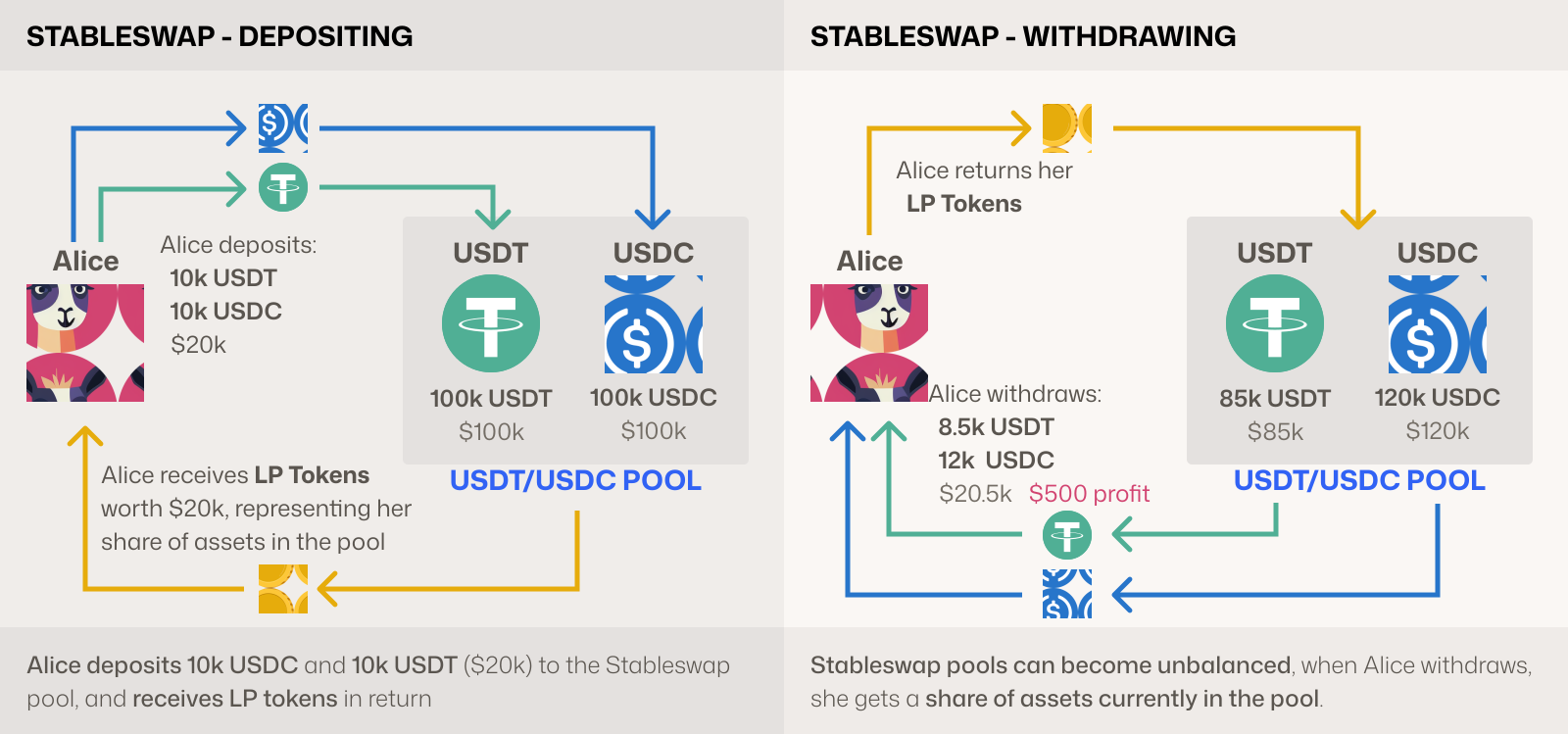
Adding liquidity requires depositing an equal value of two tokens into a designated pool. For example, providing liquidity to a USDC/USDT pool involves depositing both assets in a 1:1 ratio. Protocols like Aerodrome and Curve offer streamlined interfaces for this process, but users must ensure they understand the impermanent loss risks associated with peg deviations.
What is the minimum entry barrier for stableswap liquidity?
Entry barriers are generally low for retail participants, with many pools accepting deposits as small as $10. However, institutional investors often require higher minimums to access premium yield opportunities or to minimize transaction fees relative to their capital. Always check the specific pool’s minimum deposit requirements on the protocol’s official documentation.
Are stableswap pools audited and safe?
Reputable stableswap protocols undergo rigorous audits by firms like Trail of Bits and OpenZeppelin. Despite these audits, smart contract risk remains. Users should verify the audit status of any pool before depositing funds. Official protocol documentation and reputable industry reports from KPMG or Summit provide additional context on security standards and regulatory compliance.
No comments yet. Be the first to share your thoughts!