
Why StableSwap Hub matters for stablecoins
Standard automated market makers (AMMs) struggle with stability. When you swap assets that share the same dollar peg, traditional constant-product formulas cause unnecessary friction. The math penalizes trades that should theoretically be near-zero cost, leading to high slippage and poor execution for large orders. This inefficiency is the specific problem StableSwap Hub solves.
StableSwap Hub acts as the center of gravity for these trades by utilizing specialized invariant curves. These curves flatten the price impact around the peg, allowing large volumes to move with minimal price distortion. Instead of the steep penalty curve of a standard swap, the liquidity pool behaves like a deep, flat reservoir, ensuring that your stablecoins retain their intended value during the exchange.
For 2026, this mechanism is not just a convenience; it is a necessity for capital efficiency. Whether you are managing a treasury or executing a high-frequency arbitrage strategy, the reduction in slippage directly translates to preserved capital. StableSwap Hub consolidates this liquidity, offering a unified interface to access these optimized pools without the fragmentation of legacy DEXs.
How StableSwap Hub reduces trading costs
StableSwap Hub is the center of gravity for low-slippage trading because it solves a fundamental flaw in standard AMMs. Traditional Constant Product Market Makers (CPMMs), like those powering most decentralized exchanges, rely on the formula $x * y = k$. This mathematical model works well for volatile assets, but it punishes traders swapping pegged assets.
When you trade two assets that should have the same value, a standard AMM sees the price difference as an arbitrage opportunity. To rebalance the pool, the AMM forces a steep price curve. This results in high slippage, meaning you receive fewer tokens than expected, or you pay a hidden fee that erodes your capital efficiency.
StableSwap Hub avoids this trap by using a specialized invariant algorithm. Instead of a single rigid curve, it blends the behavior of different market maker models. In the "stable" region, where asset prices are close to their peg, the curve flattens out significantly. This creates a high-resistance band that absorbs large trades with minimal price impact. As the price deviates further from the peg, the curve transitions to behave more like a standard AMM, protecting liquidity providers from impermanent loss during volatility.
The result is a trading environment where small fees don't matter as much as the slippage itself. For stablecoin portfolios, this distinction is everything. It allows for efficient rebalancing, large treasury movements, and arbitrage without the heavy costs that plague standard pools.
The following table contrasts how StableSwap Hub performs against standard AMM mechanics in typical stablecoin scenarios.
| Feature | Standard AMM (CPMM) | StableSwap Hub |
|---|---|---|
| Slippage on pegged assets | High (steep curve) | Low (flat curve) |
| Price impact for large trades | Significant | Minimal |
| Capital efficiency | Low for stablecoins | High |
| Arbitrage cost | Expensive | Cheaper |
| Best use case | Volatile pairs | Pegged/stable pairs |
Top StableSwap Hub integrations in 2026
The StableSwap Hub is the center of gravity for stablecoin trading, connecting protocols that prioritize liquidity depth over speculative volatility. In 2026, the most effective integrations are those that allow users to swap pegged assets with minimal slippage, regardless of market conditions. These platforms leverage specialized invariant curves to keep prices stable while maintaining high volume.
Curve Finance: The Institutional Standard
Curve Finance remains the primary implementation of StableSwap technology, offering the deepest liquidity for stablecoin pairs. Its architecture supports up to eight coins in plain pools, allowing for complex arbitrage between assets like USDC, USDT, and DAI. The protocol’s focus on low fees and high capital efficiency has made it the default choice for institutional traders and large-volume operations. By keeping the invariant curve tight, Curve minimizes the price impact that typically plagues traditional AMMs.
StableChain: Native Payment Infrastructure
StableChain represents a newer approach by building StableSwap logic directly into a Layer 1 blockchain designed for global commerce. Rather than running as a side protocol, StableSwap is native to its infrastructure, enabling instant USD₮ payments with predictable costs. This integration removes the need for bridge tokens or complex wrapping, offering a frictionless user experience for merchants and consumers. The result is a payment rail that feels as fast as credit card processing but settles on-chain.
PancakeSwap: Accessible Stable Pair Trading
PancakeSwap has integrated StableSwap features to cater to a broader audience seeking low-slippage swaps for stable pairs. This feature allows users to trade assets like HAY, BUSD, and USDT with greater precision than standard pools. The integration brings the benefits of StableSwap technology to a more retail-friendly interface, making it easier for everyday users to move capital between stablecoins without suffering significant losses to slippage. It serves as a bridge between high-frequency trading and casual DeFi usage.
The choice of integration depends on your trading volume and asset needs. For large institutional flows, Curve’s deep liquidity is unmatched. For seamless payments, StableChain’s native approach reduces friction. For accessible, everyday swaps, PancakeSwap offers a user-friendly entry point. All three leverage the core StableSwap Hub mechanism to ensure that your stablecoins remain stable, even when the rest of the market is volatile.


As an Amazon Associate, we may earn from qualifying purchases.
Strategies for earning yield with stablecoins
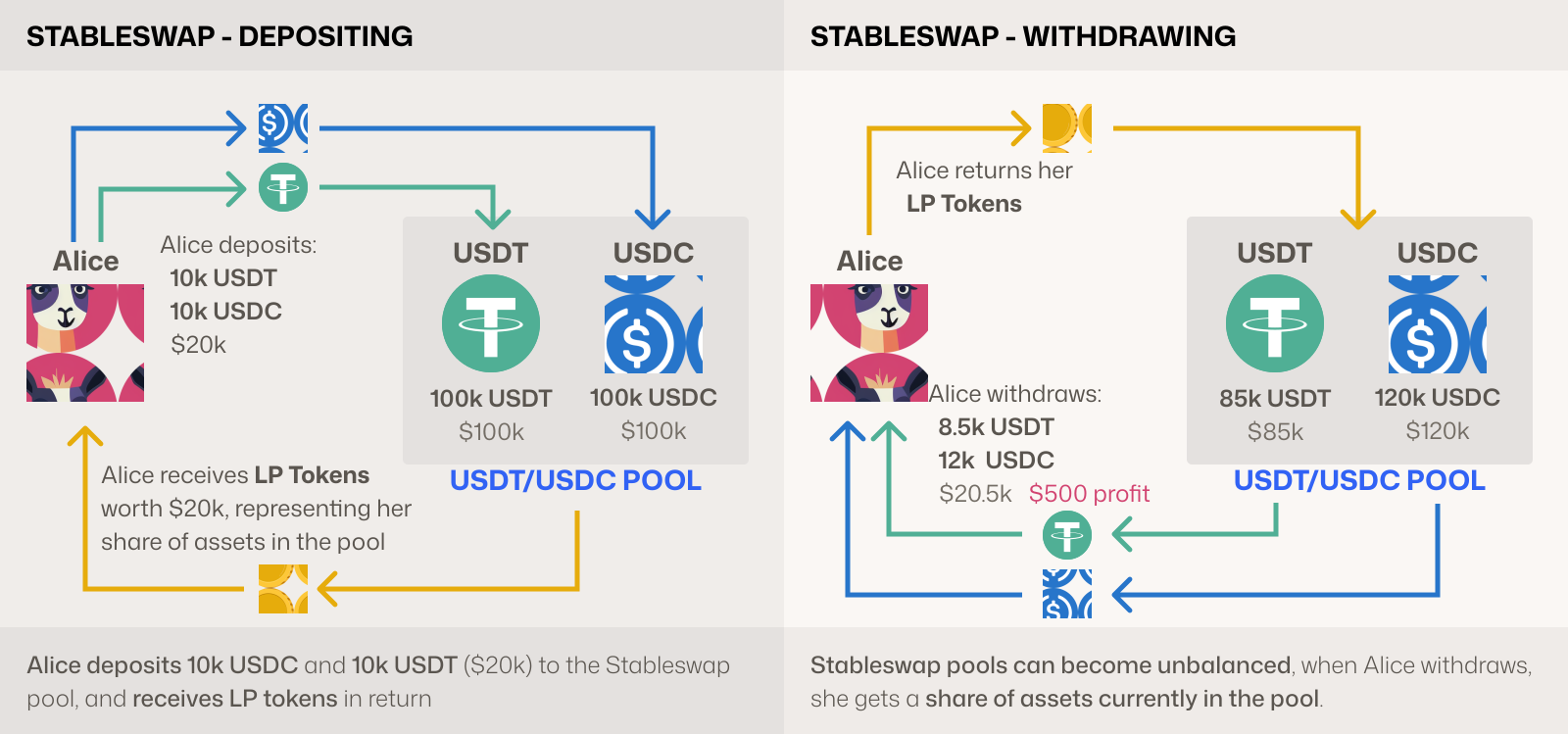
StableSwap Hub is the center of gravity for investors seeking to earn yield through liquidity provision. Unlike traditional lending platforms that cap interest rates, StableSwap pools allow users to earn trading fees and protocol incentives by providing capital to automated market makers. This approach turns idle stablecoins into productive assets while maintaining low slippage for traders.
The core mechanism relies on specialized invariant algorithms, such as the StableSwap invariant used by Curve Finance. These pools are designed for assets that are tightly correlated, like USD-pegged stablecoins (USDT, USDC, DAI) or liquid staking tokens. Because the price ratio between these assets rarely deviates significantly, the pools can offer deep liquidity with minimal impermanent loss compared to volatile asset pairs. This stability makes them ideal for conservative yield strategies in 2026.
To maximize returns, investors often look for pools with high trading volume and active incentive programs. Many protocols distribute governance tokens or additional rewards to liquidity providers, effectively boosting the base trading fee yield. By analyzing volume data and incentive schedules, users can identify pools that offer the best risk-adjusted returns. This requires a bit of due diligence, but the potential for consistent yield is significantly higher than standard savings accounts.
While the technical setup may seem complex, the underlying principle is straightforward: you provide liquidity, traders pay fees, and you earn a share. The key is selecting pools with sufficient depth to minimize slippage and risks. As the stablecoin market matures, these pools have become a foundational component of DeFi yield strategies, offering a reliable way to generate income from digital dollars.
Frequently asked: what to check next
How does StableSwap Hub differ from Uniswap V2?
Uniswap V2 uses a constant product formula ($x * y = k$) which creates high slippage when swapping assets of similar value, like USDC and USDT. StableSwap Hub uses a hybrid invariant curve that flattens the price impact around the peg. This allows for large trades with minimal price distortion, whereas Uniswap V2 would see significant slippage on the same trade.
Is impermanent loss a risk in StableSwap pools?
Impermanent loss is significantly reduced in StableSwap pools because the assets are pegged to the same value (e.g., USDC and USDT). Since the price ratio remains close to 1:1, the divergence between assets is minimal compared to volatile pairs like ETH/USDC. However, it is not zero; if the peg breaks, liquidity providers can still experience losses.
What are the best stablecoin pairs to trade on StableSwap Hub?
The most efficient pairs are those with the highest liquidity and tightest pegs, such as USDC/USDT, DAI/USDC, and FRAX/USDC. These pairs benefit most from the flat curve mechanics, offering the lowest slippage for traders and the best fee yields for liquidity providers.
No comments yet. Be the first to share your thoughts!