
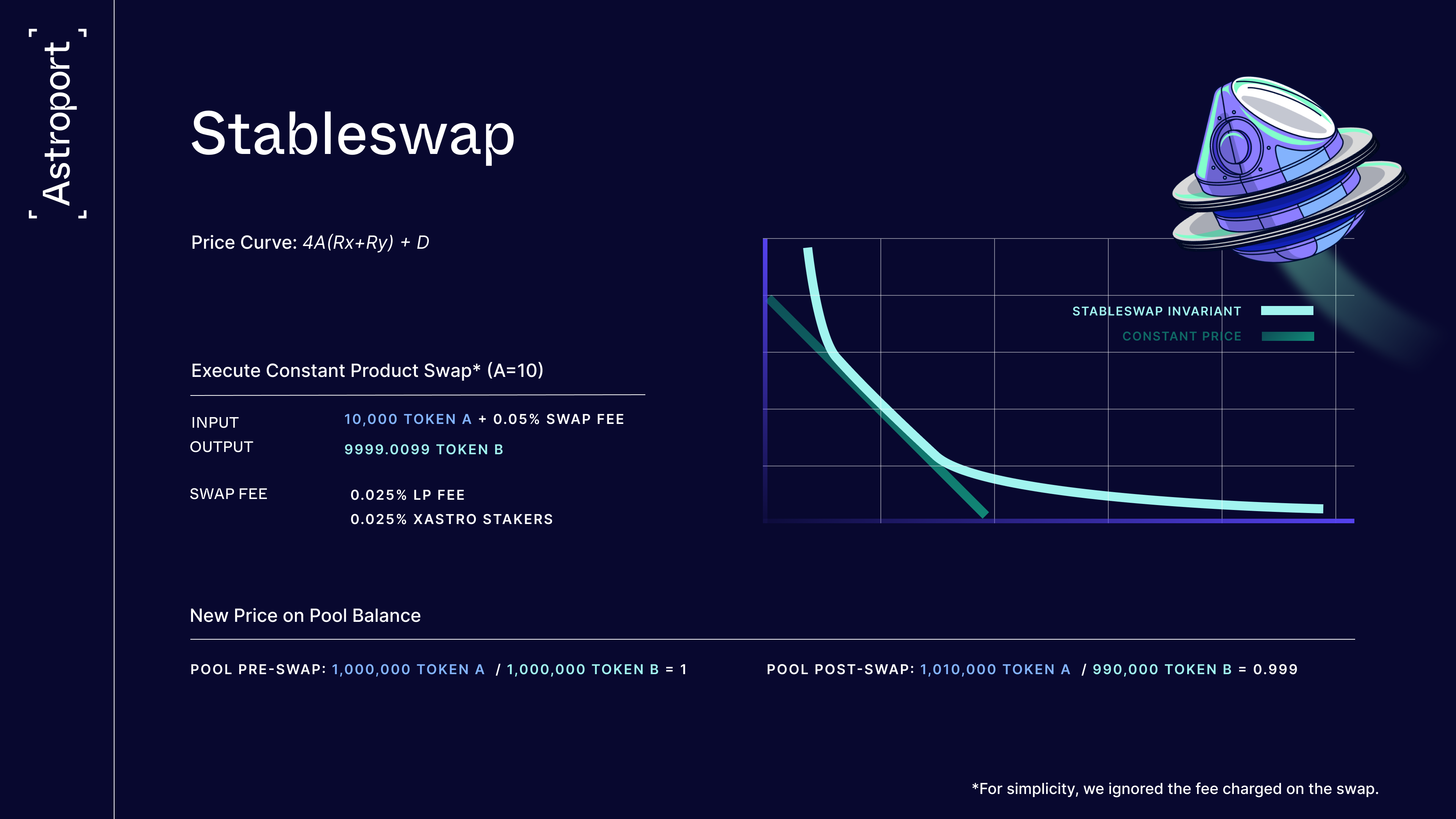
Why StableSwap Beats Standard Swaps
Standard automated market makers (AMMs) rely on a constant product formula that assumes high volatility. When trading volatile assets against stablecoins, this creates significant slippage. StableSwap pools use a different invariant designed specifically for pegged assets. Because stablecoins like USDC and USDT stay near $1.00, the protocol allows large trades with minimal price impact.
The algorithm keeps the price flat near the peg, only introducing volatility when the asset drifts far from its target value. This mechanical advantage matters most for high-volume traders. A standard AMM might charge 0.3% to 1% slippage on a $1 million trade. StableSwap pools typically keep slippage under 0.05% for the same volume.
The efficiency comes from the StableSwap invariant, developed by Curve Finance. This algorithm prioritizes stability over the constant product formula used by Uniswap V2. It allows traders to exit positions quickly without moving the market price against them. This makes StableSwap the preferred tool for arbitrage and large-scale stablecoin management.
Set up your wallet and network
To trade StableSwap pools effectively, your technical environment must match the protocol’s infrastructure. StableSwap algorithms rely on specific on-chain mechanics to maintain peg stability. If your wallet is not configured for the correct network or lacks the necessary stablecoin approvals, transactions will fail or execute at a significant loss.
Find the right liquidity pool
Choosing the correct pool determines whether your trade executes at the expected price or suffers unexpected losses. High-liquidity pools absorb large orders with minimal price impact, while low-liquidity pools expose you to slippage. You should prioritize pools with deep reserves and consistent trading activity to ensure stability.
The Curve StableSwap exchange utilizes a specific algorithm designed to facilitate the trading of stablecoins and other stable assets with high efficiency. This mechanism keeps pegged assets tightly coupled, but it only works effectively when there is sufficient depth in the pool. Without adequate liquidity, the algorithm cannot maintain the peg during volatility, leading to higher costs for traders.
Evaluate TVL and 24h Volume
Total Value Locked (TVL) and 24-hour volume are the two most reliable indicators of pool health. TVL represents the capital committed to the pool, acting as a buffer against price swings. Volume indicates active usage, suggesting that the pool is liquid enough to handle your order size without significant deviation from the market price.
When comparing pools, look for those with a healthy ratio of volume to TVL. A pool with high TVL but zero volume may be stagnant. Conversely, a pool with low TVL but high volume is risky, as it may lack the reserves to sustain large trades. Aim for pools that demonstrate both depth and activity.
Compare Pool Options Side-by-Side
Use the table below to compare top StableSwap pools by TVL, 24h Volume, and Swap Fee. These metrics help you identify which pools offer the best balance of low slippage and reasonable costs.
| Pool Name | TVL (USD) | 24h Volume (USD) | Swap Fee |
|---|---|---|---|
| 3pool (USDC/USDT/DAI) | 850M | 120M | 0.04% |
| stETH/ETH | 620M | 45M | 0.04% |
| FRAX/USDC | 180M | 30M | 0.04% |
| LUSD/USDC | 45M | 8M | 0.04% |
The image above illustrates the depositing and withdrawing process in StableSwap pools. Understanding this flow helps you visualize how your assets interact with the pool's reserves. Always verify the asset pair matches your needs before initiating a swap.
Check Swap Fees and Impermanent Loss
Swap fees directly reduce your returns, so even a 0.01% difference matters on large trades. Most StableSwap pools charge low fees, typically around 0.04%, but some specialized pools may charge more. Compare fees across similar pools to minimize costs.
Impermanent loss is less of a concern in StableSwap pools due to the algorithm's design, but it is not zero. If the peg of one asset breaks significantly, you may experience losses. Stick to pools with established assets and strong pegs to mitigate this risk.
Execute the swap with minimal slippage
StableSwap pools use a modified invariant that keeps prices stable near the peg, but they are not immune to slippage. When trading assets that have drifted from their target value or when executing large orders, the pool's internal pricing curve can shift significantly. To protect your capital, you must preview the trade and configure your slippage tolerance before confirming the transaction.
1. Preview the trade amount
Before committing any funds, enter the exact amount of tokens you wish to swap into the input field. The interface will display the estimated output amount, the exchange rate, and the price impact. This preview is critical because it reveals how much of the pool's liquidity is being consumed. If the price impact is high, consider splitting your order.
2. Set appropriate slippage tolerance
Slippage tolerance is the maximum percentage difference between the quoted price and the execution price. For most stablecoin pairs that are tightly pegged, a setting of 0.1% to 0.5% is usually sufficient. However, if you are trading volatile pairs or if the market is moving rapidly, you may need to increase this to 1% or higher. Setting it too low risks transaction failure; setting it too high risks losing value to front-running or market volatility.
3. Confirm and sign the transaction
Once you are satisfied with the preview and slippage settings, click the swap button. Your wallet will prompt you to sign the transaction. Review the gas fees and the total cost of the transaction. After signing, the transaction is broadcast to the network. You can track its status using a block explorer.
Avoid common stableswap pitfalls
StableSwap pools are not risk-free vaults. Even with the invariant designed to minimize slippage, specific mechanics can erode capital if you do not monitor pool health. The primary risks involve de-pegging events, impermanent loss in non-1:1 assets, and inefficient gas usage during high volatility.
De-pegging and Slippage
A stablecoin losing its peg introduces immediate arbitrage opportunities that drain liquidity from the pool. When one asset in a pair drops significantly below $1, large swaps can occur at unfavorable rates, causing further de-pegging. Always verify the current peg status of underlying assets before entering a large position. Do not assume that "stable" means "static"; the StableSwap invariant works best when assets remain within a tight range.
Impermanent Loss in Non-1:1 Pools
Impermanent loss is not limited to volatile crypto pairs. It occurs in any StableSwap pool where assets are not perfectly 1:1 pegged, such as USD-pegged vs. EUR-pegged tokens or different versions of the same stablecoin. If the exchange rate diverges from 1:1, your share value in the pool may be worth less than if you had simply held the assets separately. Use the protocol’s impermanent loss calculator to estimate potential drift before depositing.
Gas Optimization
Gas costs can turn a small profit into a net loss, especially during network congestion. StableSwap transactions involve complex invariant calculations. Batch multiple swaps or deposits when possible to amortize gas fees. Avoid executing trades during peak network hours if the expected return does not justify the cost.
Track your yield farming rewards
Yield farming on Curve is not a set-and-forget activity. While providing liquidity to StableSwap pools generates trading fees, the additional token incentives (such as CRV or gauge rewards) require active monitoring to capture. If you do not track your position, you risk leaving significant returns on the table or missing critical rebalancing windows.
Start by verifying your liquidity deposit. Once your assets are in the pool, you receive LP tokens representing your share. On most interfaces, you must explicitly stake these LP tokens in the corresponding gauge to accrue voting power and yield rewards. Without staking, you only earn trading fees, not the protocol incentives.
Monitor your accrued rewards regularly. Most platforms display a "Claim" or "Harvest" button that aggregates unclaimed CRV and other tokens. Set a calendar reminder to check this weekly. Claiming rewards frees up capital and prevents token decay if the reward schedule changes. Some advanced users reinvest these rewards immediately to compound their position, while others take profits to stabilize their portfolio.
Finally, review your position’s health. Check the pool’s APY trends and any upcoming governance votes that might affect your gauge. If the yield drops significantly or the peg of a stablecoin in the pool weakens, consider withdrawing and reallocating your liquidity to a more efficient pool.
-
Deposit liquidity into the StableSwap pool
-
Stake received LP tokens in the gauge to activate rewards
-
Claim accrued tokens (CRV, 3CRV, etc.) regularly
-
Reinvest rewards or rebalance based on current APY
No comments yet. Be the first to share your thoughts!