
Why StableSwap 2026 matters for traders
The landscape of decentralized trading has shifted. While traditional automated market makers (AMMs) rely on a constant product formula that penalizes large trades with high slippage, StableSwap pools use specialized invariant curves to keep prices steady. In 2026, this distinction is critical. Traders no longer accept significant price impact for swapping assets like USDC for USDT or DAI. The goal is simple: execute large orders without moving the market against yourself.
Curve Finance pioneered the StableSwap invariant, an algorithm designed specifically for assets that share a similar value. Instead of the hyperbolic curve that drains liquidity quickly as trades grow, StableSwap flattens the curve near the peg. This structure mimics the efficiency of centralized limit order books while maintaining the self-custody benefits of DeFi. As AI-driven optimization tools began integrating with these pools in late 2025, the precision of these curves improved, allowing for tighter spreads and lower fees for everyday traders.
The result is a trading environment where stability is not just a feature but a requirement. For institutions and high-volume traders, the difference between a 0.05% slippage on a StableSwap pool and a 2% slippage on a standard AMM is the difference between profitability and loss. Understanding this mechanism is the first step to navigating the low-slippage pools that define 2026.
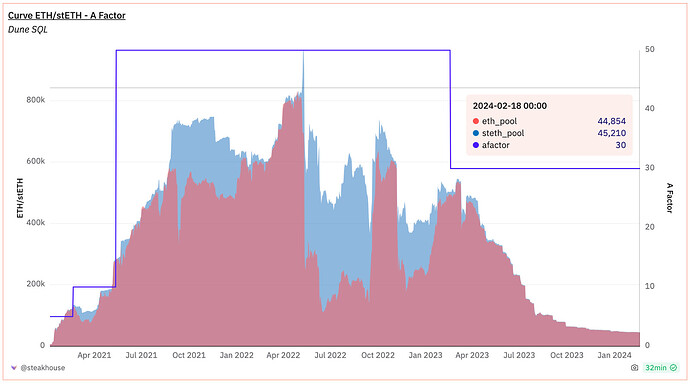
Curve Finance: The institutional standard
Curve Finance remains the dominant force in the stableswap landscape, specifically engineered for minimal slippage on high-volume stablecoin pairs. Its proprietary StableSwap invariant algorithm, detailed in the official Curve documentation, balances the low slippage of constant product markets with the efficiency of constant sum markets. This mathematical foundation allows Curve to handle large trades without the price impact that plagues other decentralized exchanges.
For traders prioritizing low slippage, Curve’s dominance is not just theoretical; it is reflected in its consistent ranking as the top stablecoin swap platform. The protocol’s liquidity is concentrated in specific pools designed for assets with pegged values, such as USDC, USDT, and DAI. This concentration creates deep order books that absorb market fluctuations, making it the preferred choice for institutional players and large retail traders alike.
The following table outlines the key metrics for Curve’s top stablecoin pools, highlighting the relationship between total value locked (TVL) and trading volume.
Top Curve Stablecoin Pools
-
3pool (DAI/USDC/USDT)
The largest pool with over $1.5B TVL, offering the deepest liquidity for major stablecoins. -
stETH Pool
Facilitates liquid staking derivatives with lower volatility than standard stablecoins. -
FRAX/USDC
A stable-frax pair pool that maintains tight pegs through specialized incentives.
PancakeSwap StableSwap for retail access
PancakeSwap has carved out a distinct niche for traders who prioritize speed and low costs over the deepest liquidity found on older protocols. By implementing its StableSwap module on the BNB Chain, the platform offers retail users a streamlined way to swap between pegged assets with minimal friction. This setup is particularly useful for those who need to move capital quickly without paying high gas fees or suffering from significant price impact.
The core advantage lies in the invariant curve slippage function, which keeps trading costs low even when large volumes are moved. Unlike standard automated market makers that can see prices swing wildly with small trades, StableSwap maintains a tight peg. This means you can convert between assets like BUSD, USDT, or BNB-backed USD without the usual slippage penalties that eat into profits. The result is a trading experience that feels closer to a centralized exchange, but with the transparency of on-chain settlement.
For everyday traders, this means faster execution and more predictable outcomes. Whether you are rebalancing a portfolio or hedging against volatility, PancakeSwap’s interface abstracts away much of the complexity. You get the stability of pegged assets with the accessibility of a user-friendly dApp. This combination makes it a go-to destination for those who want to trade stablecoins efficiently without navigating the complexities of larger, more congested networks.

Emerging AI-Driven Liquidity Strategies
By 2026, the static nature of traditional stableswap pools is giving way to dynamic, AI-driven liquidity strategies. This shift addresses a fundamental weakness in the Curve StableSwap invariant: its reliance on fixed weights that can drift from equilibrium during market stress. Instead of waiting for manual rebalancing, modern protocols deploy machine learning agents to monitor on-chain data in real time, predicting volatility spikes before they impact trader slippage.
These AI algorithms act as autonomous portfolio managers, continuously adjusting pool weights to minimize friction. When the model detects an incoming surge in trading volume for a specific asset pair, it pre-emptively shifts liquidity to the side of the pool most likely to be depleted. This proactive adjustment keeps the trading curve flat, ensuring that large orders execute with minimal price impact even during periods of high market turbulence.
The integration of AI also extends to risk management. By analyzing historical order book data and macroeconomic indicators, these systems can identify potential arbitrage opportunities or flash loan attacks. They respond by temporarily widening spreads or pausing specific pool operations, protecting liquidity providers from impermanent loss while maintaining market integrity.
Note: AI algorithms predict volatility spikes to adjust pool parameters in real-time, reducing slippage for traders and protecting LPs from sudden market shifts.
This evolution marks a departure from passive liquidity provision. Traders benefit from tighter spreads and faster execution, while liquidity providers enjoy more stable returns. As stablecoin adoption grows, AI-driven pools will likely become the standard for low-slippage trading, offering a more resilient infrastructure for the digital economy.
Comparing fees and slippage across platforms
Choosing the right stableswap pool depends on balancing transaction costs against execution quality. A lower fee does not always mean better value if the pool has low liquidity or high slippage on large orders. Traders must weigh the base trading fee against the price impact to find the optimal route for their specific trade size.
The table below compares the cost structures and performance metrics of leading stablecoin swap platforms. These figures reflect typical conditions for major pairs like USDC/USDT or USDC/DAI. Always verify current APY and pool depth before executing, as these metrics shift with market activity.
| Platform | Base Fee | Avg. Slippage (<$10k) | Supported Chains |
|---|---|---|---|
| Curve Finance | 0.04% | < 0.05% | Ethereum, Arbitrum, Polygon |
| PancakeSwap | 0.01% | 0.05-0.1% | BSC, Ethereum, zkSync |
| Uniswap V3 | 0.01-0.05% | 0.1-0.3% | Ethereum, Arbitrum, Base |
| Eco Routes | Variable | < 0.05% | Multi-chain Aggregator |
Curve remains the default for large-volume swaps due to its specialized StableSwap invariant, which minimizes slippage for pegged assets. PancakeSwap offers the lowest base fees on BSC, making it attractive for smaller, frequent trades. Uniswap V3 provides capital efficiency but requires careful range selection to avoid idle liquidity, which can increase slippage if not managed properly.

Frequently asked questions about stableswap
Stableswap pools are designed to minimize slippage when trading assets with similar values, like USDC for USDT or ETH for wstETH. Unlike standard automated market makers that use a constant product formula, stableswap algorithms adjust their pricing curves to mimic an order book, keeping transaction costs low even for large trades.
Why use stableswap pools instead of standard DEXs?
Standard DEXs charge high fees on large trades due to price impact. Stableswap pools mitigate this by using a hybrid invariant that behaves like a constant product for small deviations but like a bonding curve for larger ones. This structure ensures that a $10,000 swap of USDC to USDT costs significantly less in slippage than on a typical Uniswap V2 pair. For a technical breakdown of the invariant, see the Curve StableSwap Overview.
Are stableswap pools risk-free?
No. While they reduce trading slippage, they do not eliminate smart contract risk. If the underlying code has a vulnerability, funds can be lost. Additionally, if a stablecoin de-pegs (loses its 1:1 value with its reserve asset), arbitrageurs will drain the pool, causing impermanent loss for liquidity providers. Always review the audit status of the protocol before depositing.
How do I get started with stableswap trading?
Begin by connecting a non-custodial wallet like MetaMask to a reputable aggregator or direct interface like Curve.fi. Start with small test transactions to understand gas fees and slippage tolerance settings. For a comparative look at the best swap platforms in 2026, refer to the Eco Support Guide.
What is the best stableswap pool for low fees?
The best pool depends on the specific assets. For USD-pegged coins (USDC, USDT, DAI), the Curve 3Pool or its newer variants typically offer the lowest fees. For liquid staking derivatives (ETH vs. stETH), Curve’s stETH pool is the industry standard for liquidity and depth. Always check the annual percentage yield (APY) and trading volume to ensure the pool is active and safe.
No comments yet. Be the first to share your thoughts!