
Why StableSwap Hub reduces slippage
Trading stablecoins requires a different approach than trading volatile assets like Bitcoin or Ethereum. On standard automated market makers, even small imbalances between assets can cause significant price drift, known as slippage. StableSwap Hub addresses this by using the StableSwap invariant, an algorithm specifically designed for assets that maintain a similar value.
The StableSwap invariant blends the characteristics of two types of liquidity pools. It behaves like a constant product market maker (like Uniswap) when the assets are imbalanced, but shifts toward a constant sum mechanism when they are near parity. This hybrid approach allows for high capital efficiency while minimizing price impact during trades.
For example, swapping USDC for USDT involves assets that should theoretically trade at a 1:1 ratio. On a standard pool, the trading fees and price impact can erode profits quickly. StableSwap Hub’s design keeps the exchange rate tight, ensuring you get closer to the expected value for your trade.
This technical advantage is particularly important for large trades. A $10,000 swap on a standard pool might incur 0.1% to 0.5% slippage depending on liquidity depth. On StableSwap Hub, the same trade typically incurs less than 0.05% slippage, preserving more of your capital. This efficiency makes it the preferred venue for stablecoin arbitrage and treasury management.
The underlying technology is documented in the original StableSwap paper by Mike Egorov, which outlines how the algorithm minimizes divergence loss while maintaining tight pegs. By leveraging this mechanism, StableSwap Hub provides a smoother trading experience for stablecoin pairs.
Set up your wallet and connect
Before you can swap tokens on StableSwap Hub, you need a Web3 wallet that supports the Hub’s EVM network. StableSwap Hub operates as a Curve-style automated market maker (AMM) on the Hub chain, meaning it requires a non-custodial wallet to sign transactions directly. This ensures you retain control of your assets during the low-slippage swaps.
1. Install a compatible wallet
Download a reputable Web3 wallet extension or mobile app. Popular choices include MetaMask, Rabby, or Trust Wallet. Ensure your wallet is updated to the latest version to support the latest network configurations. If you are using a hardware wallet like Ledger, ensure your firmware is current.
2. Add the Hub network
Most wallets do not include the Hub network by default. You must add it manually. Navigate to your wallet’s network settings and select "Add Custom Network." Enter the official RPC URL, Chain ID, and currency symbol (HUB) provided in the Hub documentation. Using the correct network parameters is critical; connecting to the wrong chain can result in failed transactions or loss of funds.
3. Fund your wallet
Transfer a small amount of HUB tokens to your wallet address to cover gas fees. You also need the stablecoins you intend to swap (e.g., USDC or USDT) in the same wallet. Ensure the tokens are on the Hub network, not on Ethereum Mainnet or another chain. Bridge your assets if necessary using an official bridge.
4. Connect to StableSwap Hub
Open the StableSwap Hub interface in your browser. Click the "Connect Wallet" button in the top right corner. Select your wallet provider from the list. Your wallet will prompt you to sign a message to verify ownership of the address. Once signed, your wallet status will show as "Connected."
5. Verify the connection
Confirm that your wallet address and balance appear correctly in the interface. Check that the network indicator shows "Hub." If you see an error, ensure you are on the correct network and that your wallet is unlocked. A successful connection allows you to proceed to the swap interface with confidence.
Execute a low-slippage stablecoin swap
Performing a swap on StableSwap Hub requires precise configuration to maintain the low slippage that makes these pools attractive. The StableSwap invariant algorithm is designed to keep trading costs minimal for assets pegged to the same value, but only if you configure your transaction parameters correctly Curve StableSwap Exchange: Overview.
Follow this sequence to execute your trade efficiently.
Navigate to the swap interface and choose the specific stablecoin pair you wish to trade. Ensure you are selecting a pool with sufficient liquidity. Higher liquidity directly correlates with lower slippage, as the pool can absorb larger trade volumes without significantly impacting the asset price.
Adjust the slippage tolerance setting before confirming. For stablecoin swaps, a setting between 0.1% and 0.5% is typically sufficient. Setting this too low may cause the transaction to fail during high volatility, while setting it too high exposes you to unexpected price impact.
Examine the estimated price impact and the route of the swap. StableSwap Hub often routes trades through optimized paths to minimize fees. Verify that the expected output amount aligns with your requirements before proceeding. If the price impact exceeds your tolerance, consider splitting the trade into smaller orders.
Submit the transaction and sign it with your connected wallet. The StableSwap algorithm ensures that the swap remains efficient even for large volumes, provided the slippage settings are appropriate. Monitor the transaction status until it is confirmed on-chain.
Add liquidity to earn yield
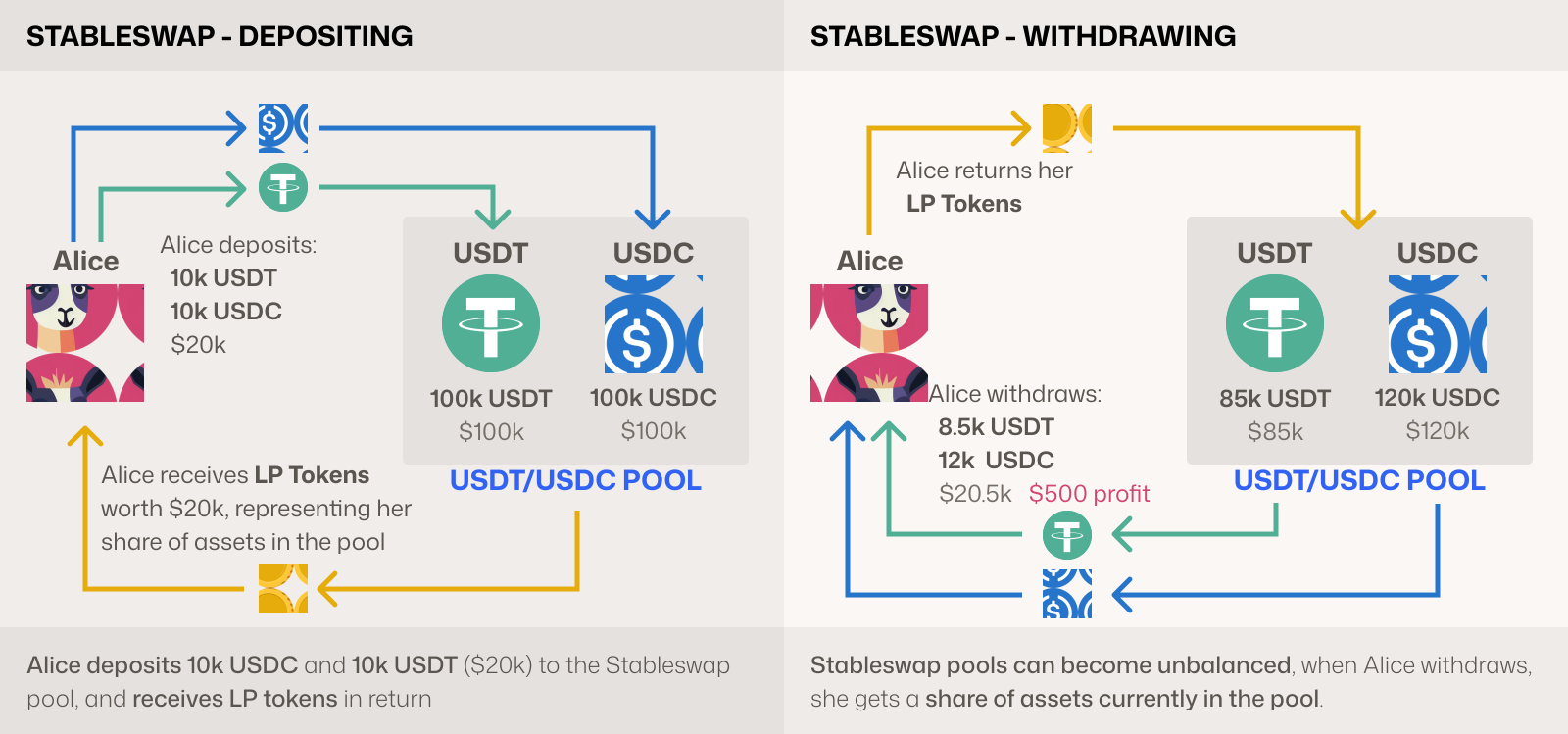
Providing liquidity on StableSwap Hub means depositing your assets into a pool so others can trade them. In return, you earn a share of the trading fees generated by the platform. This process is permissionless, meaning you can deploy your own pools or contribute to existing ones without prior approval.
The protocol supports two main pool structures: plain pools and metapools. Plain pools allow you to deposit up to eight different stablecoins, offering high diversity for traders. Metapools are designed for pairs, typically consisting of two assets, and often link to a base pool to maximize capital efficiency. Choosing the right structure depends on the specific assets you hold and the trading volume you expect.
To begin, navigate to the StableSwap Hub interface and connect your wallet. Select the pool you wish to support, ensuring you have the correct asset ratios ready. Deposit your tokens into the contract, and you will receive LP (Liquidity Provider) tokens in return. These tokens represent your share of the pool and can be held to accrue yield or traded later.
Open the StableSwap Hub and link your Web3 wallet. Ensure you are on the correct network supported by the protocol to avoid transaction failures.
Choose between a plain pool for multi-asset stability or a metapool for paired trading. Review the current fee rates and total value locked to gauge potential returns.
Enter the amounts of each asset you wish to provide. The interface will calculate the exact ratio required. Confirm the transaction in your wallet to mint your LP tokens.
For more technical details on pool deployment and asset limits, refer to the StableSwapNG GitHub repository. This resource outlines the smart contract logic behind plain and metapool structures.
Avoid common stablecoin arbitrage mistakes
Even with the efficiency of StableSwap Hub, small errors in execution can erase profits or expose you to unnecessary risk. The following pitfalls are the most common reasons traders lose money on pegged assets.
Gas fees eat into tight margins
Stablecoin arbitrage relies on tiny price differences, often fractions of a cent. If the network gas fees exceed the spread you captured, the trade is a net loss. This is especially true on congested chains where priority fees spike.
Always calculate the total cost of the transaction, including gas, before entering the trade. If the expected profit does not comfortably exceed the estimated gas cost, skip the trade. On StableSwap Hub, compare the swap output against the current average gas price for the target chain to ensure the margin remains positive.
Impermanent loss in pegged pairs
While stablecoins are designed to maintain a 1:1 peg, they can diverge during market stress. Providing liquidity or holding a balanced portfolio of two different stablecoins exposes you to impermanent loss if their pegs break asymmetrically. For example, if USDC holds $1.00 while USDT drops to $0.99, your portfolio value drops relative to holding just USD.
Monitor the peg stability of the assets you are trading. Do not assume all stablecoins are equally safe during high-volatility events. The underlying mechanism of StableSwap is designed to minimize slippage, but it cannot protect against the fundamental de-pegging risk of the underlying assets.
Smart contract vulnerabilities
Trading on any decentralized exchange carries smart contract risk. Bugs or exploits in the liquidity pool contract can lead to total loss of funds. This risk is heightened if you are interacting with lesser-known or unaudited pools.
Always start with small test transactions to ensure the contract behaves as expected. Never invest more than you can afford to lose in any single contract interaction.
Verify your trades and positions
After executing a swap on StableSwap Hub, do not assume the transaction is final without checking the blockchain. High-stakes trading requires you to confirm that your tokens arrived and that your yield positions reflect the correct balance. Use a block explorer to verify every step.
Confirm the transaction on-chain
Locate your transaction hash immediately after the swap completes. Paste this hash into a block explorer like DoraHacks to view the full execution details. Check the "Status" field for "Success" and verify the exact amounts of USDC or USDT transferred. If the status is "Fail," the transaction was reverted, and your funds remain in your wallet.
Monitor your yield positions
StableSwap Hub functions as a Curve-style AMM, offering tight spreads that can yield 1,000 USDC for 999.6 USDT instead of 997 via default routes. To track this value, view your position in the explorer’s token holdings tab. Ensure the LP tokens or staked assets are credited to your address. Regular verification prevents slippage errors from eating into your yield before you can react.
No comments yet. Be the first to share your thoughts!