
Why stableswap 2026 leads low-risk yield
Standard automated market makers (AMMs) use a fixed mathematical formula to price assets, which works well for volatile tokens but fails when prices barely move. In a traditional pool, if the price of two assets stays flat, liquidity providers still face "impermanent loss" because the formula constantly rebalances inventory against a static curve. This creates a drag on returns that makes standard pools inefficient for stablecoin pairs, where the goal is capital preservation rather than price appreciation.
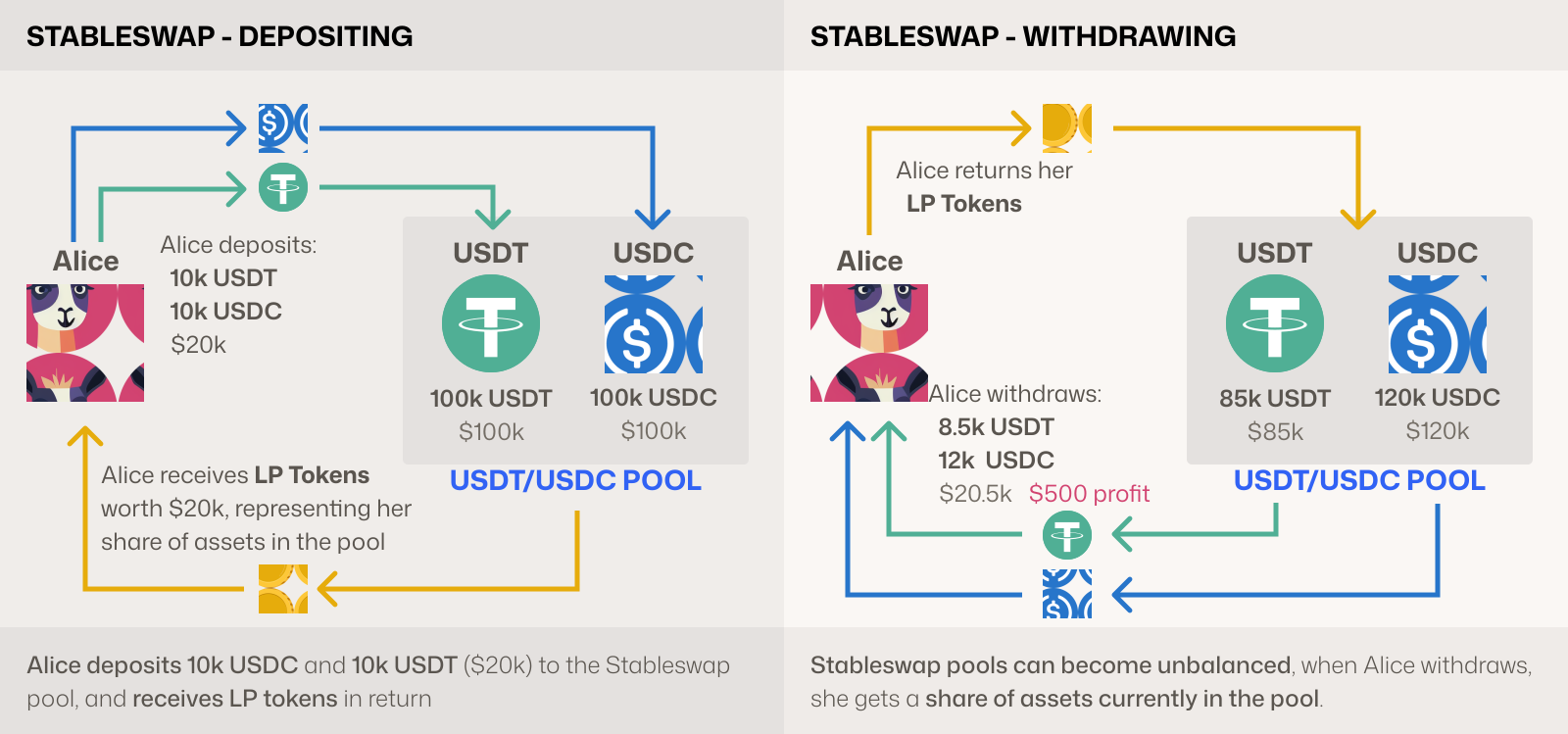
Stableswap mechanisms, pioneered by Curve Finance, solve this by introducing a hybrid pricing curve. They behave like standard AMMs when prices diverge slightly but switch to a flat linear model when assets are pegged. This design allows for massive depth with minimal slippage, meaning large trades do not disrupt the peg. For investors seeking low-risk yield, this stability is the primary advantage, as it protects principal value while generating fees from high-volume trading.
The effectiveness of this approach is visible in the market. Curve Finance continues to dominate the stablecoin liquidity landscape in 2026, holding the largest share of total value locked (TVL) in stablecoin pools compared to other venues like Uniswap V4 or Aerodrome. This concentration of liquidity validates the strategy: traders prefer stableswap pools for their efficiency, and providers earn consistent fees from that volume. Understanding this mechanism is essential before selecting specific pools for your portfolio.
This dominance creates a virtuous cycle. Higher liquidity leads to lower slippage, which attracts more traders, which in turn generates more fees for liquidity providers. While other platforms offer innovative features, the stability and depth of established stableswap pools remain the gold standard for low-risk yield strategies in the current market.
Curve Finance stableswap pools
Curve Finance remains the primary venue for stableswap 2026 strategies, acting as the deep-water harbor for low-risk yield. Its specialized StableSwap algorithm minimizes slippage for pegged assets, making it the default choice for institutional and retail capital seeking stability over speculative volatility. While other venues offer higher theoretical returns, Curve’s liquidity depth and battle-tested smart contracts provide the reliability required for serious capital preservation.
The 3pool stands as the benchmark for this approach. Comprising USDC, USDT, and DAI, it offers the deepest liquidity and most efficient swaps between the major fiat-pegged tokens. Yield here is derived primarily from trading fees and CRV token incentives, distributed through the Curve ecosystem. For investors prioritizing capital safety and consistent, modest returns, the 3pool represents the core holding in a low-risk stablecoin portfolio.
Complementing the 3pool are the crvUSD pools, which integrate Curve’s native stablecoin into the yield equation. These pools allow users to earn yield on crvUSD holdings or provide liquidity against other major stablecoins. This integration creates a closed-loop economy where stability is reinforced by the protocol’s own governance and minting mechanisms. Understanding the interplay between the 3pool and crvUSD pools is essential for assessing the current stableswap landscape.
The following table compares the top three Curve stableswap pools based on their risk profile, primary assets, and yield sources. This comparison highlights why the 3pool remains the dominant choice for conservative investors.
| Pool Name | Primary Assets | Risk Level | Yield Source |
|---|---|---|---|
| 3pool | USDC, USDT, DAI | Low | Trading fees, CRV rewards |
| crvUSD Pool | crvUSD, USDC | Low-Medium | Trading fees, crvUSD incentives |
| FRAX/USDC | FRAX, USDC | Low | Trading fees, FRAX incentives |



As an Amazon Associate, we may earn from qualifying purchases.
Convex Finance Yield Optimization
Convex Finance operates as a yield optimization layer on top of Curve Finance, designed to simplify the process of capturing the highest returns in the stableswap 2026 landscape. Rather than interacting directly with Curve’s complex voting and locking mechanisms, Convex allows liquidity providers to deposit their CRV tokens and receive boosted yields automatically. This wrapper structure effectively aggregates voting power, which translates into higher CRV emission rates for depositors without the manual overhead of governance participation.
The platform’s primary value proposition lies in its ability to unlock maximum rewards from Curve’s gauge system. By locking CRV through Convex, users gain access to additional rewards from protocol partnerships and boosted CRV emissions that are not available to direct Curve voters. This mechanism is particularly relevant for stableswap 2026 strategies, where the baseline yield from trading fees is often supplemented by these incentive layers to remain competitive against other DeFi venues.
While Convex simplifies yield farming, it does not eliminate the inherent risks of impermanent loss or protocol vulnerabilities. The platform’s governance, controlled by CVX token holders, determines which Curve pools receive boosted incentives. This means yield opportunities can shift rapidly based on governance decisions, requiring users to stay informed about the current state of the Curve ecosystem.


As an Amazon Associate, we may earn from qualifying purchases.
Uniswap V4 stablecoin strategies
Uniswap V4 has emerged as a significant contender in the stableswap 2026 landscape, offering a new architectural approach to liquidity provision. Unlike its predecessors, V4 introduces hooks—modular code snippets that allow developers to customize pool behavior without forking the core protocol. This composability enables more sophisticated stablecoin strategies, such as dynamic fee adjustments based on volatility or automated rebalancing mechanisms that were previously difficult to implement.
For liquidity providers, these hooks translate to potentially higher yields and better capital efficiency. By allowing custom logic, V4 can optimize for specific stablecoin pairs, reducing impermanent loss in certain market conditions. However, this complexity introduces new risks. Smart contract vulnerabilities in custom hooks can expose funds, requiring rigorous auditing before deployment. Investors must carefully evaluate the trustworthiness of the hook developer and the audit status of the specific pool implementation.
While Curve remains the dominant force in traditional stablecoin liquidity, V4’s flexibility is attracting developers building next-generation DeFi products. The platform’s ability to integrate with external data feeds and cross-chain bridges makes it a versatile option for those seeking to diversify beyond the standard 3pool or crvUSD strategies. As the ecosystem matures, V4 is expected to capture a larger share of the stablecoin trading volume, particularly for pairs involving newer or more volatile stablecoins.


As an Amazon Associate, we may earn from qualifying purchases.
How to choose a stableswap pool
Selecting the right stableswap pool in 2026 requires a disciplined approach. The market has matured, and low-risk yield is no longer about chasing the highest APY. It is about verifying the structural integrity of the pool. You must evaluate regulatory compliance, reserve transparency, and yield sustainability before committing capital.
Start by identifying the stablecoin issuer. In 2026, regulatory scrutiny is the primary risk factor. Check if the issuer is registered with relevant financial authorities and if they publish regular attestation reports. Pools backed by fully reserved, audited stablecoins are significantly safer than those relying on unregulated assets. The International Monetary Fund has highlighted the causal effects of stablecoin adoption on financial markets, emphasizing the need for rigorous oversight to prevent systemic shocks. Always prioritize pools where the underlying asset has a clear legal standing.
Transparency is non-negotiable. Look for pools that provide real-time on-chain visibility of their reserves. The protocol should offer regular, third-party audits of its backing assets. Avoid pools that obscure their reserve composition or rely on complex, opaque derivatives. If a pool cannot clearly demonstrate that its reserves are liquid and sufficient to cover all outstanding tokens, it is not a low-risk option. Verify that the audit reports are recent and address any identified vulnerabilities.
Yield sustainability matters more than peak returns. Examine the pool’s historical APY over the last 12 to 24 months. Consistent, moderate returns indicate a healthy, sustainable model. Spikes in APY often signal high risk or temporary incentives that will disappear. The BVNK Stablecoin Utility Report 2026 notes that over half of stablecoin holders plan to acquire more, reflecting a growing demand for reliable yield. Ensure the pool’s yield comes from genuine trading fees or legitimate lending rates, not from unsustainable token emissions.
To help you prepare for your investment journey, consider these essential resources:


As an Amazon Associate, we may earn from qualifying purchases.
By following this checklist, you can assess the stableswap landscape with confidence. Focus on compliance, transparency, and sustainability to protect your capital in 2026.
Stablecoin Yield Farming Risks
Low risk does not mean no risk. Even the most established stableswap 2026 protocols carry inherent dangers that can erase yields overnight. The primary threats fall into three categories: de-pegging events, smart contract vulnerabilities, and shifting regulatory landscapes.
De-pegging remains the most immediate threat to stablecoin value. When a stablecoin loses its 1:1 parity with the underlying asset, liquidity can vanish instantly. The International Monetary Fund has highlighted how stablecoin shocks can ripple through broader financial markets, creating contagion effects that extend beyond individual pools [[src-serp-2]]. If you are holding assets in a pool where one of the tokens de-pegs, your principal is at risk regardless of the yield generated.
Smart contract vulnerabilities present a second layer of danger. Yield farming involves interacting with complex automated market makers and lending protocols. These systems are only as secure as their code. A single bug or exploit can lead to total loss of funds. While major platforms like Curve and Uniswap V4 have undergone extensive audits, no code is immune to discovery of new vulnerabilities. Always assume that a portion of your capital is exposed to technical failure.
Regulatory shifts add another dimension of uncertainty. Governments worldwide are still defining the legal status of stablecoins and decentralized finance protocols. Changes in regulation could impact the legality of certain yield farming strategies or restrict access to specific pools. Staying informed about official policy updates is essential for long-term safety.


As an Amazon Associate, we may earn from qualifying purchases.
No comments yet. Be the first to share your thoughts!