
The stableswap hub landscape in 2026
The financial infrastructure for digital assets is undergoing a structural shift. In 2026, the stableswap hub is no longer a niche experiment but a critical convergence of regulatory clarity, institutional adoption, and algorithmic efficiency. This evolution has transformed low-slippage trading from a technical advantage into a fundamental requirement for market stability.
Regulatory frameworks are now providing the certainty institutions require. As noted by Davis Polk, congressional proposals and regulatory guidance are clarifying the legal status of crypto assets, reducing the compliance friction that previously hindered large-scale participation. This clarity is complemented by traditional finance infrastructure; Nacha’s inclusion of a dedicated stablecoin track at its Smarter Faster Payments 2026 conference signals that payment rails are finally integrating with blockchain settlement layers.
Algorithmic efficiency drives the practical mechanics of this new landscape. Stableswap protocols utilize invariant curves to maintain peg stability even during high-volume trades, ensuring that liquidity depth remains robust. This technical foundation allows for seamless interoperability between decentralized exchanges and traditional payment systems, creating a unified liquidity pool that minimizes price impact.
The result is a market where low slippage is not just a feature but a baseline expectation. This environment supports the high-frequency, high-volume transactions necessary for institutional adoption, setting the stage for a more mature and efficient digital asset ecosystem.
How AI optimizes stablecoin liquidity
Traditional automated market makers (AMMs) rely on static invariant curves, such as the StableSwap invariant, to maintain peg stability between assets. While effective for low-volatility environments, these fixed mathematical models struggle during market stress. When volatility spikes, the rigid curve often fails to adjust pricing efficiently, leading to significant slippage and impermanent loss for liquidity providers.
AI-driven liquidity provision introduces a dynamic layer to this architecture. Instead of relying on a single, unchanging formula, machine learning algorithms analyze real-time market conditions to adjust liquidity depth and pricing parameters. This allows pools to adapt to sudden shifts in supply and demand, minimizing the price impact of large trades.
The technical shift moves the focus from passive curve maintenance to active risk management. By predicting volatility patterns, AI systems can concentrate liquidity where it is most needed, effectively flattening the slippage curve during turbulent periods. This approach aligns more closely with the operational needs of institutional traders who require predictable execution costs.
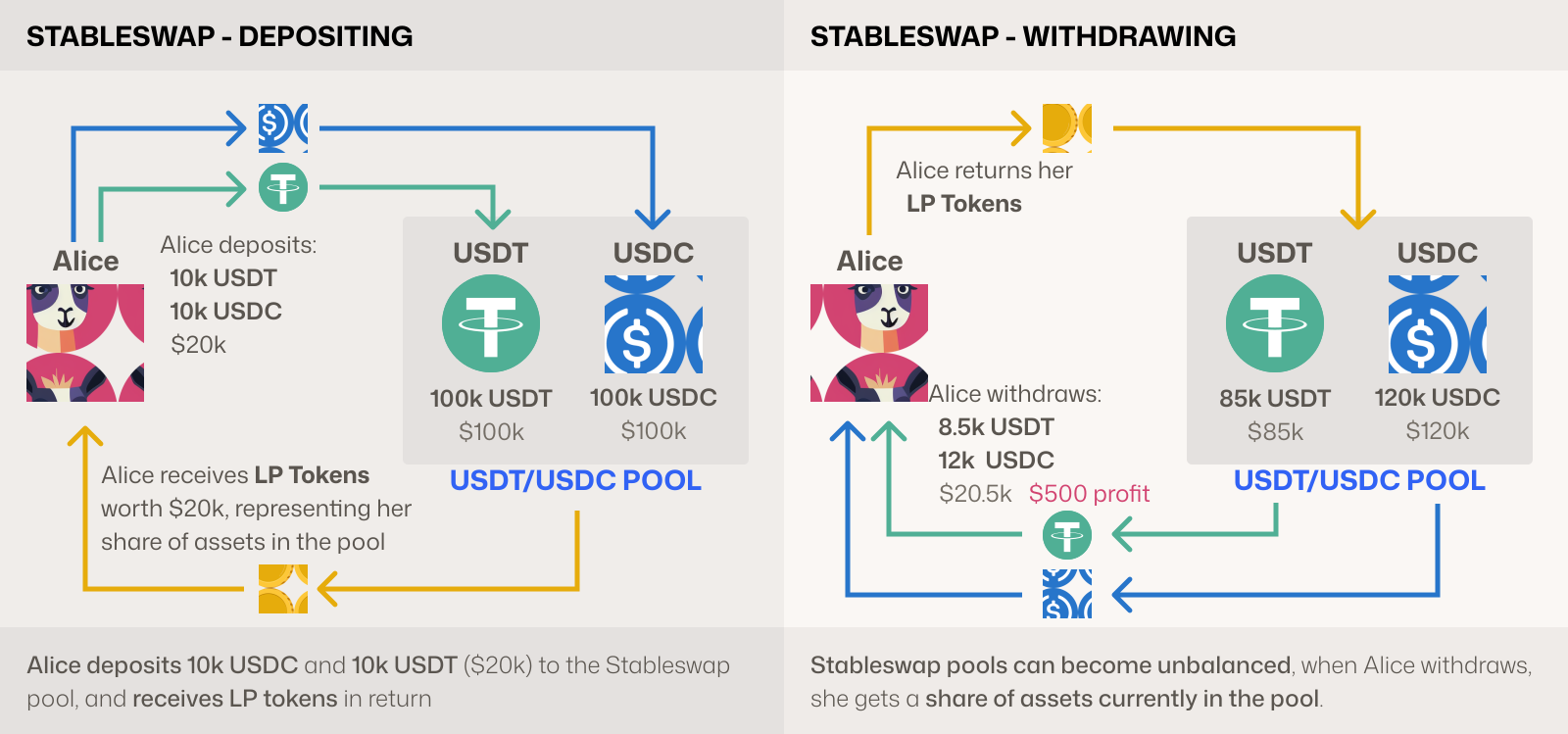
This optimization is critical for maintaining the integrity of stablecoin ecosystems. As regulatory scrutiny increases, the ability to demonstrate robust risk management through transparent, algorithmic liquidity provision becomes a key differentiator for compliant DeFi platforms.
Top venues for low slippage trading
The StableSwap Hub is not a single entity but a collection of venues optimized for specific order sizes and asset types. Selecting the right platform depends on balancing liquidity depth against execution speed. For large orders, the difference between a 0.05% and a 0.5% price impact can determine the viability of a trade.
Curve Finance remains the benchmark for stablecoin swaps under $10 million. Its StableSwap invariant minimizes slippage by adjusting the curve based on the ratio of assets in the pool. This mechanism allows for near-zero slippage when trading assets with similar pegs, such as USDC to USDT. However, as orders exceed the pool's liquidity depth, slippage increases non-linearly.
For institutional-sized trades exceeding $1 million, decentralized exchanges often fail to provide sufficient depth. In these cases, Over-the-Counter (OTC) desks and Request-for-Quote (RFQ) protocols become necessary. These venues aggregate liquidity from multiple sources, including market makers and other DEXs, to fill large orders without moving the on-chain price. While this reduces market impact, it introduces counterparty risk and potentially higher fees.
Uniswap V3 and V4 offer concentrated liquidity models that can be efficient for smaller stablecoin swaps. However, their price ranges are often too narrow for stable assets, requiring frequent rebalancing. This makes them less suitable for large, infrequent trades compared to Curve's broad-range pools or OTC desks' deep books.
| Venue | Slippage Tolerance | Supported Chains | Min Trade Size |
|---|---|---|---|
The table above compares the primary venues based on slippage tolerance, chain support, and minimum trade size. Curve dominates the sub-$10 million segment due to its specialized invariant. Uniswap offers broader asset support but higher slippage for stable assets. Eco Routes aggregates liquidity across chains to reduce fragmentation. OTC desks are the only option for institutional-sized trades, where liquidity depth is paramount.
When executing large orders, consider splitting trades across multiple venues to minimize market impact. This strategy, known as order slicing, can reduce slippage by distributing the order across different liquidity pools. However, it increases transaction complexity and gas costs. For most traders, sticking to a single venue with sufficient depth is more efficient.
Navigating cross-chain liquidity fragmentation
Traders operating in the 2026 hub ecosystem must address the structural reality of liquidity fragmentation. Stablecoins are no longer confined to single-chain silos; they move across Ethereum, Solana, and Layer 2 networks, creating disparate pools with varying depths. Without aggregation, a trader seeking a specific pair often encounters high slippage due to thin order books on any single chain.
Aggregators solve this by routing orders through multiple protocols to find the optimal invariant curve. This process mimics traditional FX market making, where liquidity is sliced and sourced from the deepest pools to minimize price impact. The mechanism relies on real-time data feeds to calculate the most efficient path, ensuring that the final execution rate reflects the true cross-chain market value.
| Chain | Avg Depth | Est. Slippage |
|---|---|---|
| Ethereum | High | 0.05% |
| Arbitrum | Medium | 0.12% |
| Solana | Low | 0.25% |
Bridge infrastructure has evolved from simple asset transfers to intelligent liquidity layers. Modern cross-chain stableswap strategies utilize wrapped assets that maintain peg stability through algorithmic rebalancing. This reduces the reliance on centralized custodians and allows for near-instant settlement between networks, a critical requirement for high-frequency trading environments.
Regulatory shifts and market structure
The regulatory landscape for stablecoins is moving from theoretical debate to operational reality. In 2026, the integration of digital assets into traditional payment rails is no longer a speculative frontier but a regulated utility. This shift is fundamentally altering how liquidity providers structure their positions on platforms like StableSwap Hub, prioritizing compliance and auditability over pure yield optimization.
The establishment of a dedicated stablecoin track at Nacha’s Smarter Faster Payments 2026 conference signals a decisive institutional embrace of these assets. By carving out specific sessions for stablecoin infrastructure, payment processors are acknowledging that stablecoins require distinct regulatory frameworks separate from general crypto speculation. This institutional validation reduces the compliance burden for platforms that adhere to strict reserve transparency, allowing them to operate with greater certainty in cross-border settlements.
Compliance is no longer just a legal checkbox; it is a liquidity driver. Liquidity providers are increasingly favoring platforms that can demonstrate real-time proof of reserves and adhere to emerging federal guidelines. As noted in recent analyses by Davis Polk, the convergence of congressional proposals and industry standards is creating a more robust, albeit complex, regulatory environment. Platforms that fail to integrate these compliance layers risk losing access to institutional capital, which now demands a higher degree of market structure integrity.
No comments yet. Be the first to share your thoughts!