
Institutional liquidity reshapes stablecoin markets
The stablecoin sector is undergoing a structural shift as institutional capital moves from retail-dominated trading venues to deeper, more resilient liquidity pools. In 2026, the focus has moved beyond simple arbitrage toward sophisticated yield strategies that require the depth and stability previously unavailable in decentralized markets. This transition is reshaping how large-scale capital enters and exits positions, reducing the volatility spikes that once characterized the space.
Institutional players are increasingly relying on protocols like PancakeSwap’s StableSwap, which utilizes invariant curve functions to minimize slippage on stable pairs. This technology allows for larger trade sizes without the price impact that would deter traditional finance participants. As noted by Defillama, these specialized pools offer a lower-friction environment for trading stable assets, making them attractive for treasury management and settlement layers rather than speculative trading.
The broader impact of this shift is visible in the growing correlation between stablecoin adoption and traditional financial market stability. Research from the International Monetary Fund highlights that stablecoin shocks now have measurable causal effects on U.S. financial markets, indicating that these digital assets are no longer isolated experiments. The influx of institutional liquidity acts as a buffer, absorbing shocks and providing the depth necessary for high-volume transactions.
To visualize this evolving landscape, the following chart tracks the volume trends and liquidity depth of major stablecoin pairs. It reflects the increasing participation of institutional actors who demand the reliability and scale that modern stableswap mechanisms provide.
Low slippage mechanics in concentrated pools
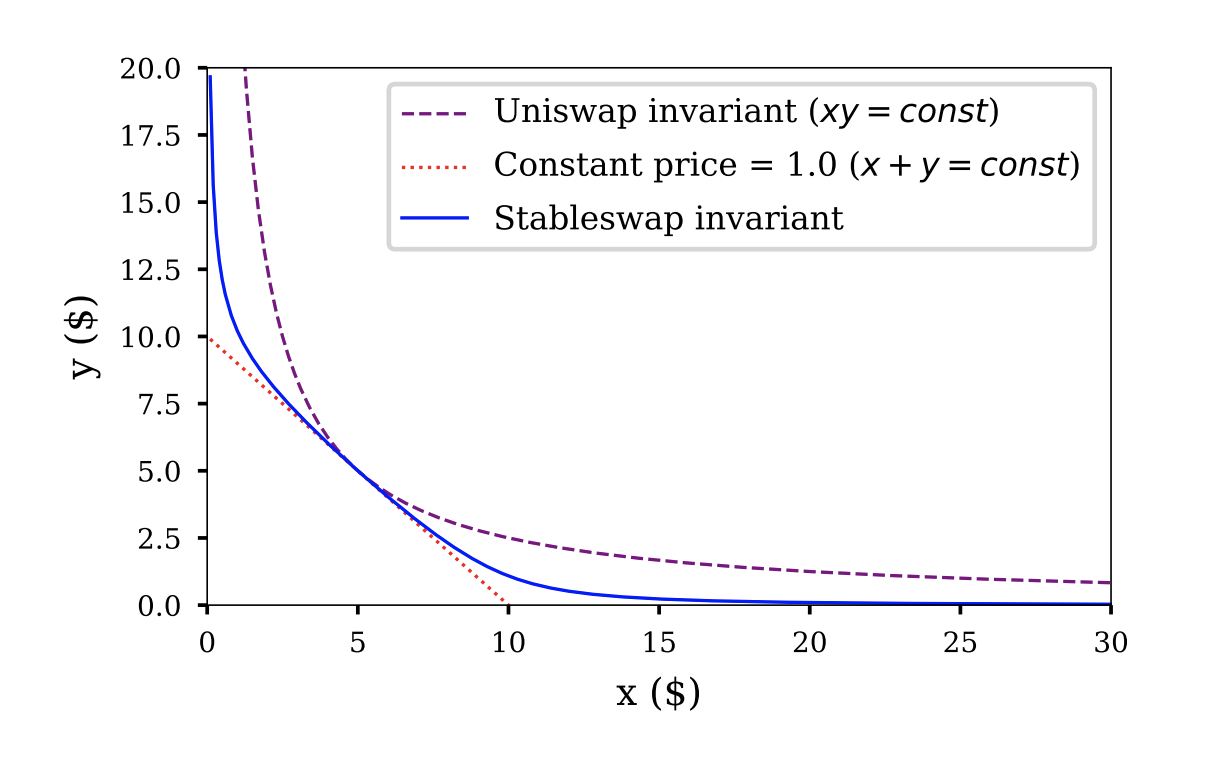
Institutional traders face a distinct challenge: moving large volumes without degrading the market price. Standard Automated Market Maker (AMM) models, which rely on the constant product formula ($x * y = k$), impose exponential slippage costs as order size increases relative to pool liquidity. For a fund executing a $10 million stablecoin swap, this friction can result in significant unintended losses, often forcing the use of traditional OTC desks or fragmented liquidity sources.
StableSwap invariant curves solve this by flattening the price impact curve near the peg. By blending the constant sum behavior of stablecoins with the constant product behavior of volatile assets, these pools maintain high effective liquidity for large orders. This mechanism allows institutions to execute substantial trades with minimal price deviation, preserving capital efficiency that standard AMMs cannot match.
The technical advantage lies in the curve’s ability to absorb order flow without steepening the slope. While a standard AMM’s price curve becomes vertical as liquidity is depleted, a StableSwap curve remains nearly horizontal for stablecoin pairs. This ensures that the execution price remains close to the peg, even as the trade size grows. The result is a trading environment where large institutional orders can be filled with the precision typically reserved for centralized limit order books.
For context on how these mechanics perform across different platforms, see the PancakeSwap StableSwap overview, which highlights the TVL and fee structures associated with this specific invariant model. Understanding these mechanics is essential for selecting the right venue for large-scale stablecoin operations.
Yield optimization strategies for 2026
Institutions are moving beyond simple holding strategies to actively manage liquidity in StableSwap pools, prioritizing risk-adjusted returns over raw APY. The core challenge remains minimizing impermanent loss (IL) while capturing trading fees and potential governance incentives. This section details how capital is deployed to capture yield while minimizing impermanent loss.
Stablecoin Concentration and Fee Capture
The most common institutional entry point is providing liquidity to high-volume, low-volatility stablecoin pairs. By concentrating liquidity in assets like USDC and USDT, institutions can capture trading fees with minimal IL risk. Curve Finance remains the dominant venue for this strategy due to its specialized invariant curve function, which maintains peg stability better than standard AMMs.
| Protocol | Est. APY | IL Risk | TVL |
|---|---|---|---|
| Curve Finance | 2-5% | Low | $4.2B |
| PancakeSwap StableSwap | 3-8% | Medium | $850M |
| Uniswap V3 Stable Pools | 1-4% | Medium | $1.1B |
Dynamic Rebalancing and Hedging
Advanced strategies involve dynamic rebalancing of liquidity positions. Institutions use automated bots to adjust liquidity ranges based on market volatility, ensuring capital efficiency without exposing the portfolio to significant depegging events. Some protocols offer built-in hedging mechanisms or insurance pools to protect against smart contract risks or extreme market shocks.
Yield Aggregation and Auto-Compounding
Yield aggregators simplify the process by automatically compounding rewards and shifting capital between pools to chase the best risk-adjusted returns. These platforms handle the complexity of cross-chain deployments and fee harvesting, allowing institutions to gain exposure to multiple StableSwap strategies through a single token. This approach reduces operational overhead and provides a more consistent yield stream.
2026 regulatory clarity drives institutional adoption
The regulatory landscape for stablecoins has shifted from ambiguity to structured integration, removing the primary friction point for institutional capital. In 2026, frameworks from major financial bodies have moved stablecoins from speculative assets to recognized components of the payments infrastructure. This shift is not merely theoretical; it is reshaping how large-scale capital flows into decentralized finance.
The International Monetary Fund’s recent analysis, Stablecoin Shocks, provides empirical evidence that stablecoin adoption now has measurable causal effects on U.S. financial markets. By developing novel measures of these shocks, the IMF acknowledges that stablecoins are no longer peripheral but integral to financial stability and market dynamics. This official recognition reduces the "unknown risk" premium that previously kept traditional finance at bay.
Simultaneously, traditional payment networks are formalizing their relationship with digital dollars. Nacha’s Smarter Faster Payments 2026 initiative explicitly created a dedicated track for stablecoins, signaling that core payment rails are ready for settlement layer integration. This move parallels how credit cards were once viewed as niche before becoming ubiquitous. For institutional players, this means stablecoins are now governed by established compliance standards rather than gray-area protocols.
These developments enable larger capital inflows by providing the legal certainty required for risk management teams to approve allocations. As compliance friction decreases, the cost of entering DeFi stablecoin markets drops significantly, paving the way for the next wave of institutional yield strategies.
No comments yet. Be the first to share your thoughts!