
What makes StableSwap different
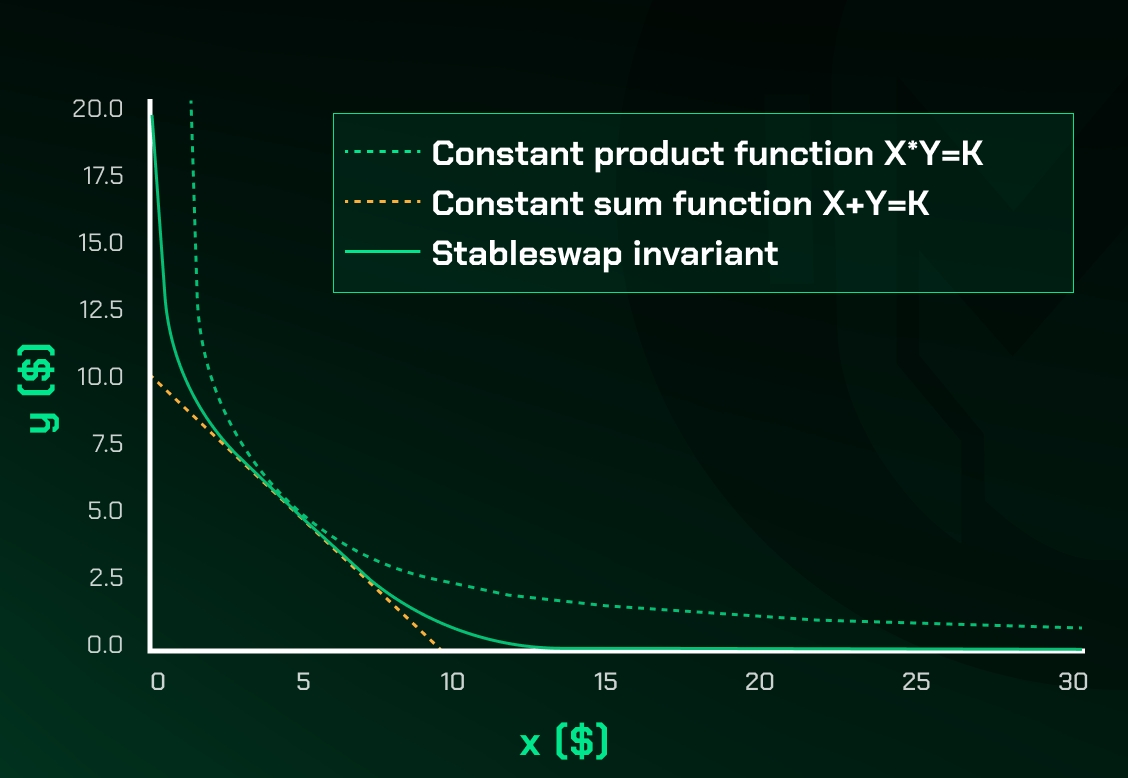
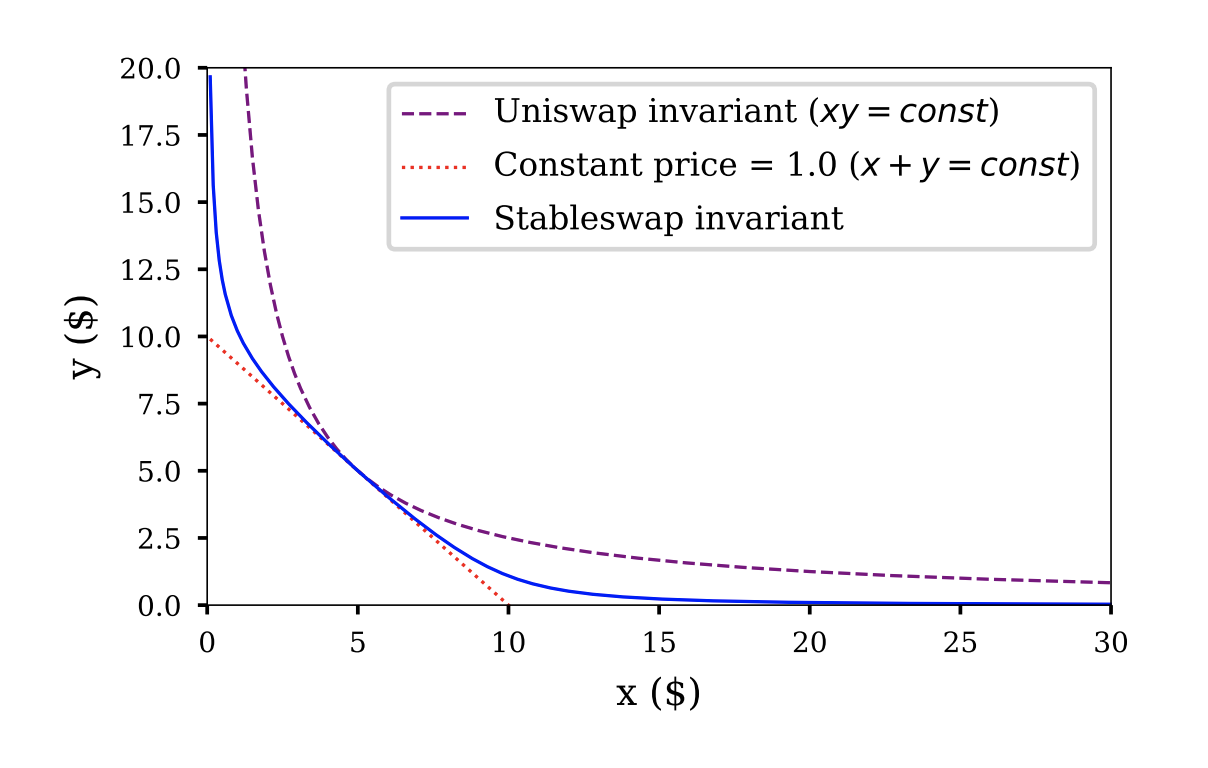
Standard automated market makers like Uniswap V2 rely on a constant product formula ($x \cdot y = k$). This works well for volatile assets but creates significant slippage for stablecoins. When trading assets with nearly identical values, such as USDC for USDT, the standard curve forces traders to accept poor prices even for small amounts, effectively punishing liquidity for stability.
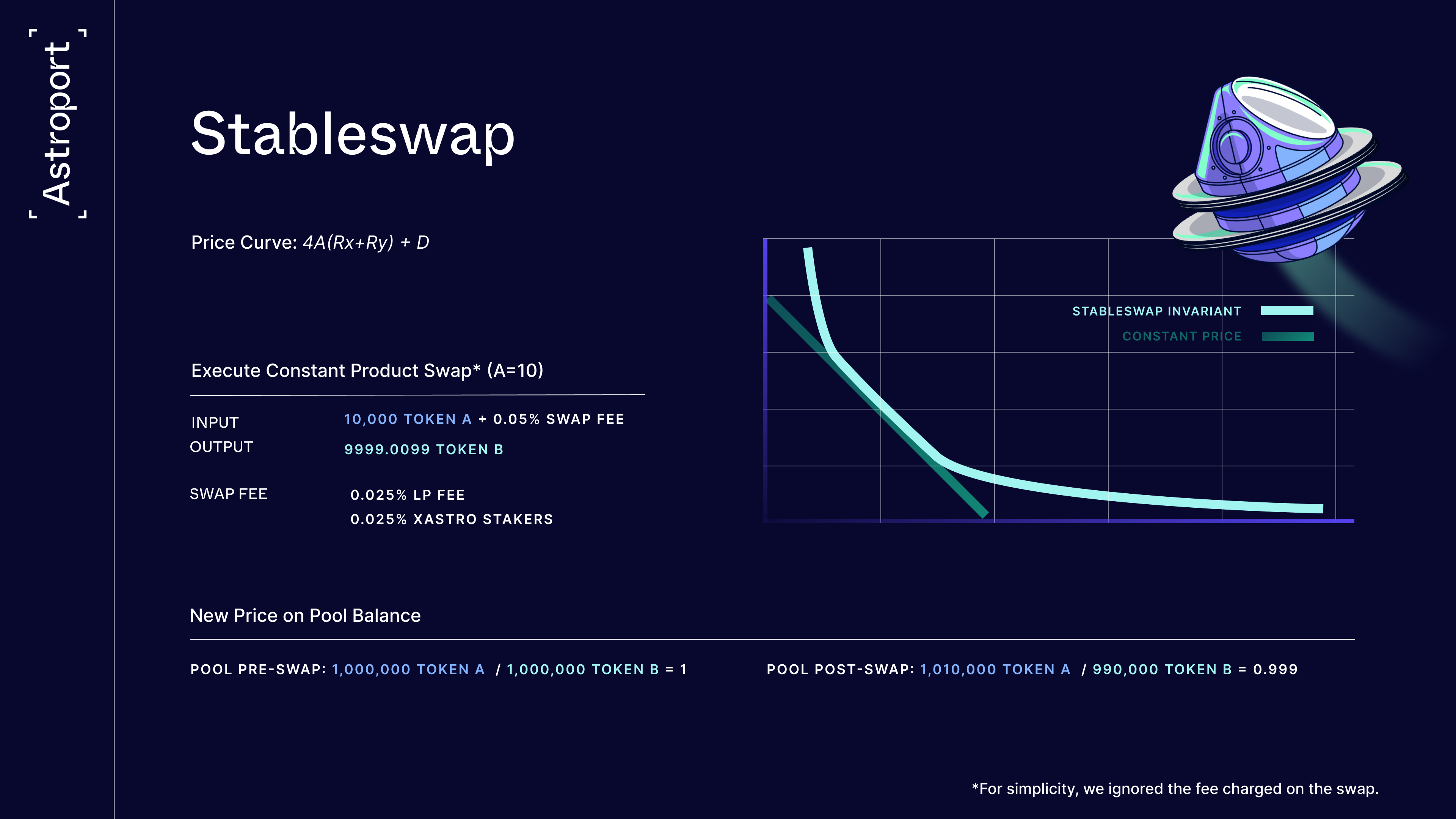
StableSwap solves this by using a hybrid invariant that changes its behavior based on the price ratio of the tokens. It combines two mathematical models to offer the best of both worlds. Near parity—where the assets are equal in value—it behaves like a constant sum model. Far from parity, it gracefully transitions to a constant product model.
Think of the StableSwap curve as a road that straightens out when you are close to your destination. In a standard AMM, the road is always curved, forcing you to take a longer, less efficient path even when you are almost there. StableSwap flattens the curve for pegged assets, allowing large trades to execute with minimal price impact. This mechanism is why platforms like Curve Finance can handle millions in stablecoin swaps with slippage often under 0.05%.
This design choice directly addresses the inefficiency of traditional AMMs. By prioritizing stability in the high-volume, low-volatility range, StableSwap makes it viable for arbitrageurs and large holders to trade without moving the market against themselves. The result is a trading environment where peg maintenance is easier and costs are significantly lower than on legacy protocols.
How to Deposit into a StableSwap Pool
Adding liquidity to a StableSwap pool requires precision because the protocol relies on assets staying near their peg. Unlike standard AMMs that penalize price divergence heavily, StableSwap is designed for assets like USDC and USDT that should trade at $1.00. If you deposit assets that have drifted significantly from their peg, you risk receiving fewer shares than expected or introducing instability into the pool.
The process is straightforward, but checking the peg ratio before confirming your deposit is non-negotiable. Follow these steps to ensure your liquidity is added correctly and efficiently.
Navigate to the DEX’s StableSwap section and connect your wallet. Ensure you are on the correct network where the target pool resides. Verify the contract address if you are interacting directly with a specific pool to avoid phishing sites.
Choose the specific stablecoin pair you intend to support, such as USDC/USDT or DAI/USDC. Review the pool’s current total value locked (TVL) and trading volume to ensure it is active and has sufficient depth for your deposit size.
Before entering amounts, check the current price of the assets. If one asset has depegged (e.g., USDC trading at $0.99), the pool will adjust the deposit ratio. Depositing a depegged asset at face value can result in receiving fewer LP tokens than the actual value warrants. Wait for the peg to stabilize or adjust your input amounts accordingly.
Input the amounts for each asset. Most interfaces allow you to enter one amount and auto-calculate the other based on the current peg. Ensure the ratio matches the pool’s current composition to avoid immediate impermanent loss upon deposit. For equal-weight pools, aim for a 50/50 value split.
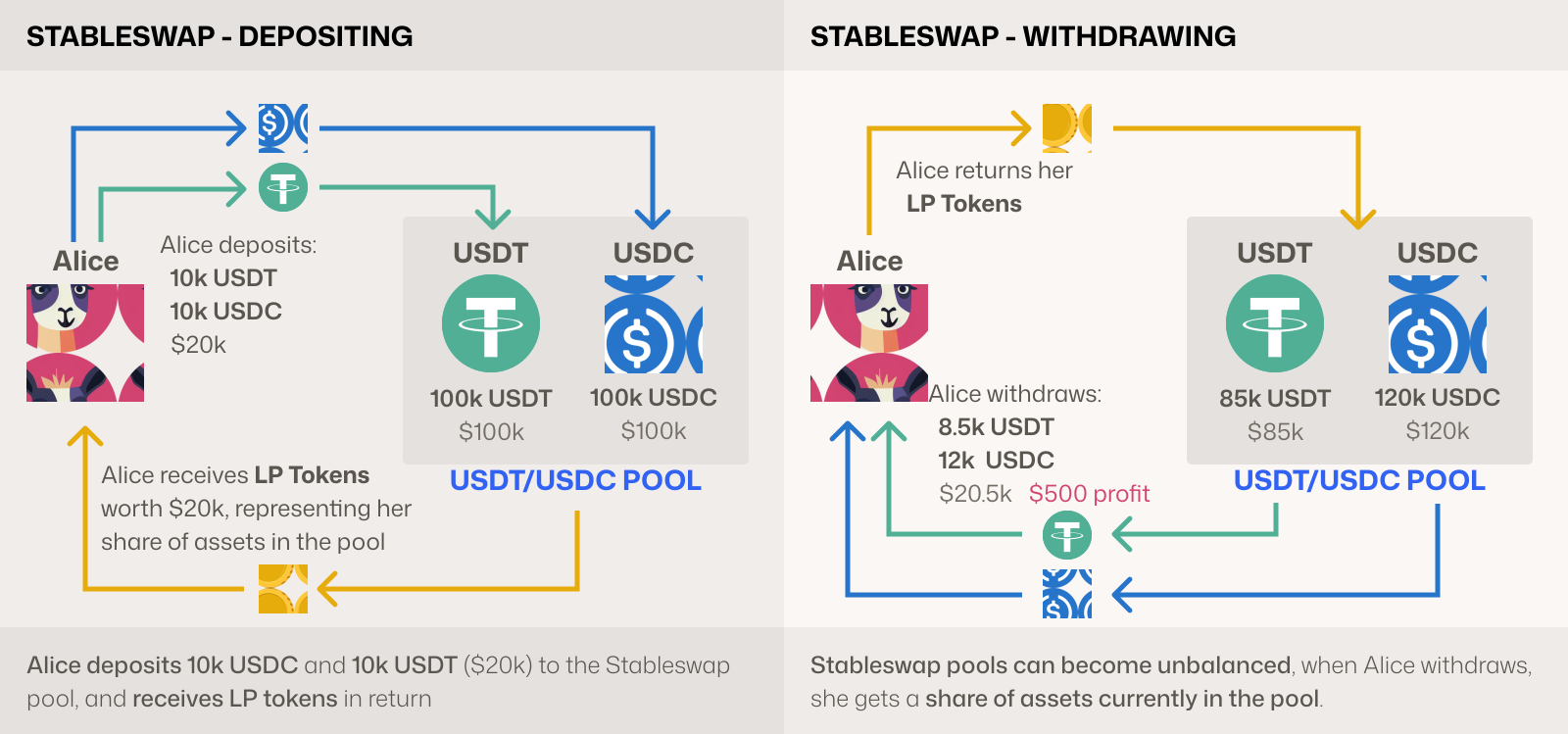
Review the transaction details, including the estimated LP tokens you will receive. Approve the token spend if it is your first time interacting with this pool, then confirm the deposit transaction. Once mined, your LP tokens will appear in your wallet, representing your share of the pool’s liquidity.
Managing peg drift and rebalancing
StableSwap pools are designed to keep asset ratios near a 1:1 peg, but market forces will inevitably push them off balance. When one asset in a pair (like USDC) becomes more popular for trading than the other (like USDT), the pool accumulates more of the less-traded asset. This drift is the primary driver of impermanent loss in these environments. If left unchecked, the pool becomes inefficient, and traders begin to face higher slippage, defeating the purpose of using a StableSwap pool.
Think of the pool like a reservoir with two inflow pipes. If water flows in faster from one side, the level on that side rises. To keep the reservoir functional, you must periodically balance the levels. In DeFi, this "balancing" is done by arbitrageurs or liquidity providers who rebalance the pool, but you can also monitor and manage this process yourself to protect your capital.
Monitoring the pool ratio
The first step in managing drift is knowing when the peg is slipping. Most StableSwap interfaces, including Curve’s StableSwapNG, provide real-time data on the current reserve ratios. You should check the "Pool Details" or "Stats" tab to see the current balance of each asset.
For a standard 2-coin pool, the target ratio is 50:50. If the pool holds 60% USDC and 40% USDT, it is imbalanced. This imbalance means that USDT is in higher demand, and the pool is effectively "short" on USDT. If you are a liquidity provider, this imbalance increases your exposure to the asset that is losing value relative to the peg.
Rebalancing the pool
Rebalancing involves adjusting your position to restore the 50:50 ratio. This is typically done by adding liquidity to the underrepresented asset or by swapping some of your holdings. Here is how to approach it:
- Check the current ratio: Look at the pool’s reserve data. If the ratio deviates significantly from 50:50 (e.g., >55/45), it may be time to act.
- Calculate the imbalance: Determine how much of each asset you need to add or remove to return to balance. Most DEX interfaces provide a "Add Liquidity" screen that shows the required amounts to maintain a balanced position.
- Execute the rebalance: You can rebalance by:
- Adding liquidity: Deposit more of the underrepresented asset to bring the ratio back to 50:50. This often earns you additional fees because you are providing the asset in higher demand.
- Swapping: If you hold an imbalanced position, you can swap some of the overrepresented asset for the underrepresented one. This is essentially arbitrage, and you may profit from the price difference.
Why rebalancing matters
Rebalancing is not just about maintaining a clean ratio; it is about minimizing impermanent loss. When a pool is imbalanced, the value of your holdings in the pool diverges from simply holding the assets in your wallet. By rebalancing, you lock in gains from the arbitrageurs who have been trading against the imbalance, effectively reducing your net loss.
For example, if USDC appreciates against USDT, the pool will hold more USDC. By rebalancing, you sell some of your USDC (which has appreciated) for USDT (which has not), locking in the profit. If you do not rebalance, you remain exposed to the full price drop of USDC, which can lead to significant impermanent loss.
Practical steps for liquidity providers
- Set up alerts: Use a portfolio tracker or a DEX interface that alerts you when a pool’s ratio deviates from 50:50.
- Rebalance regularly: Check your positions weekly or after significant market moves. Frequent, small rebalances are often more effective than infrequent, large ones.
- Watch fees: Rebalancing may incur transaction fees. Ensure that the potential gain from reduced impermanent loss outweighs the cost of the transaction.
By actively managing peg drift, you turn a passive investment into a more controlled strategy, ensuring that your StableSwap pool remains efficient and profitable.
Common mistakes that increase slippage
Even with StableSwap pools designed for low slippage, specific user errors can still erode your yield and increase effective impermanent loss. The most frequent pitfalls involve ignoring the underlying peg mechanics and mismanaging deposit ratios.
Depositing unbalanced ratios
StableSwap pools rely on a specific balance between assets to maintain the peg. If you deposit an unbalanced ratio—such as 90% USDC and 10% USDT—you are effectively providing liquidity that the pool cannot efficiently rebalance. This imbalance forces the pool to rely more heavily on the less abundant asset, increasing the slippage for all subsequent trades. Always aim for a 50/50 split or the pool's target ratio to ensure the curve functions as intended.
Ignoring swap fees
Swap fees are often overlooked but directly impact your net yield. High-frequency trading within a StableSwap pool can accumulate fees that exceed the generated yield, especially if you are not actively rebalancing. For example, a 0.04% fee on every swap adds up quickly. If your strategy involves frequent adjustments, calculate the total fee drag against your expected APY to ensure the trade remains profitable.
Neglecting peg management
Stablecoins are not always perfectly pegged. Minor deviations, such as USDC trading at $0.998, can signal underlying stress in the pool. If you continue to provide liquidity without monitoring these deviations, you may inadvertently buy the weaker asset and sell the stronger one, leading to losses. Regularly check the peg status of your paired assets to avoid holding devalued positions.
Quick Checklist for StableSwap Deposits
Before adding liquidity to a StableSwap pool, verify the underlying assets are holding their peg. For pairs like USDC/USDT, check that the price deviation is minimal; even a 0.1% drift can signal temporary instability. Check the pool’s Total Value Locked (TVL) to ensure there is sufficient depth to absorb your deposit without significant price impact. Confirm the fee tier matches your holding period—stableswap pools often have lower fees than standard AMMs, but only if the assets remain stable.
After depositing, monitor the ratio of your deposited tokens. If the peg breaks and one asset depegs, your liquidity position will become imbalanced. Rebalance if the ratio deviates more than 1% from the target. This prevents impermanent loss from compounding during volatile periods. Use a dashboard like DefiLlama to track real-time TVL and fee revenue, ensuring the pool remains active and profitable for your contribution.
Frequently asked questions about StableSwap
StableSwap pools use a specialized bonding curve to keep trading costs low for assets like USDC and USDT. Here are the most common technical questions about how these pools handle value and fees.
No comments yet. Be the first to share your thoughts!