
Why StableSwap Hub Models Matter
Standard automated market makers (AMMs) like Uniswap v2 rely on a constant product formula ($x * y = k$). While effective for volatile assets, this model imposes heavy slippage on stablecoin pairs. When swapping between assets pegged to the same value—such as USDC and USDT—the price should remain near 1:1. However, the geometric curve of a standard AMM forces the price to deviate significantly as liquidity is consumed, punishing traders with high fees and poor execution.
StableSwap algorithms solve this by flattening the curve near parity. As described in the original Berkeley research, this mechanism behaves like a Uniswap pool for large deviations but acts like a constant sum pool when prices are close. This dual nature allows for near-zero slippage on stablecoin swaps, making these protocols the critical infrastructure for DeFi liquidity.
This efficiency creates a "hub" effect. Liquidity concentrates in these specialized pools because they offer the best rates for the most common DeFi activity: moving between stable assets. Protocols that implement this model become the primary destinations for arbitrageurs, yield farmers, and everyday users needing to rebalance portfolios without losing value to slippage.
Curve Finance: The Deep Liquidity Standard
Curve Finance operates as the primary infrastructure layer for stablecoin trading, accounting for the majority of volume in the DeFi stableswap category. Its dominance stems from a specialized algorithm designed to minimize slippage when swapping assets with similar pegs, such as USDC to USDT or various wrapped Bitcoin variants. For traders and liquidity providers, this means tighter spreads and lower capital inefficiency compared to standard automated market makers.
The protocol’s core innovation lies in its dual-algorithm approach. Standard Stableswap pools handle assets that maintain a tight peg to $1, ensuring that price impact remains negligible even for large trades. This stability is critical for institutional players and high-frequency arbitrageurs who require predictable execution costs. The system effectively creates a deep pool of liquidity where traditional AMMs would see significant price slippage.

Beyond pegged assets, Curve introduced Cryptoswap pools to address the volatility of correlated crypto assets like ETH and stETH. These pools use a different mathematical model that adapts to higher price variance while still offering better rates than conventional exchanges. This expansion allows Curve to capture liquidity from volatile but correlated assets, broadening its utility beyond simple stablecoin swaps.
Liquidity providers on Curve are incentivized through a combination of trading fees and CRV token emissions. This dual-reward structure encourages long-term capital commitment, which further deepens the liquidity pools and reduces costs for traders. The result is a self-reinforcing cycle where deep liquidity attracts more volume, which in turn attracts more liquidity. This dynamic makes Curve the default choice for any large stablecoin transaction in the decentralized ecosystem.
Saber: Solana’s Efficient StableSwap Hub
Saber operates as a specialized automated market maker (AMM) built exclusively for mean-reverting stablecoin pairs on the Solana blockchain. Unlike general-purpose DEXs that handle volatile assets, Saber focuses entirely on assets pegged to the US dollar, creating a dedicated liquidity corridor for stablecoin swaps. This specialization allows the protocol to offer tighter spreads and lower slippage compared to broader exchanges, making it a critical component for high-frequency stablecoin trading.
The platform leverages Solana’s high throughput to execute swaps with minimal latency and negligible transaction fees. For traders moving large volumes of USDC, USDT, or other stablecoins, these cost savings are significant. Saber’s design ensures that liquidity remains deep and efficient, even during periods of high market activity, by optimizing its curve parameters specifically for assets that rarely deviate from their peg.
The visual interface of Saber reflects its functional focus, providing a clean environment for users to swap between supported stablecoin pairs without the clutter of unrelated trading pairs. This streamlined approach reduces user error and enhances the overall trading experience for those primarily interested in stablecoin arbitrage or yield farming strategies.
Cross-Chain StableSwap Hubs
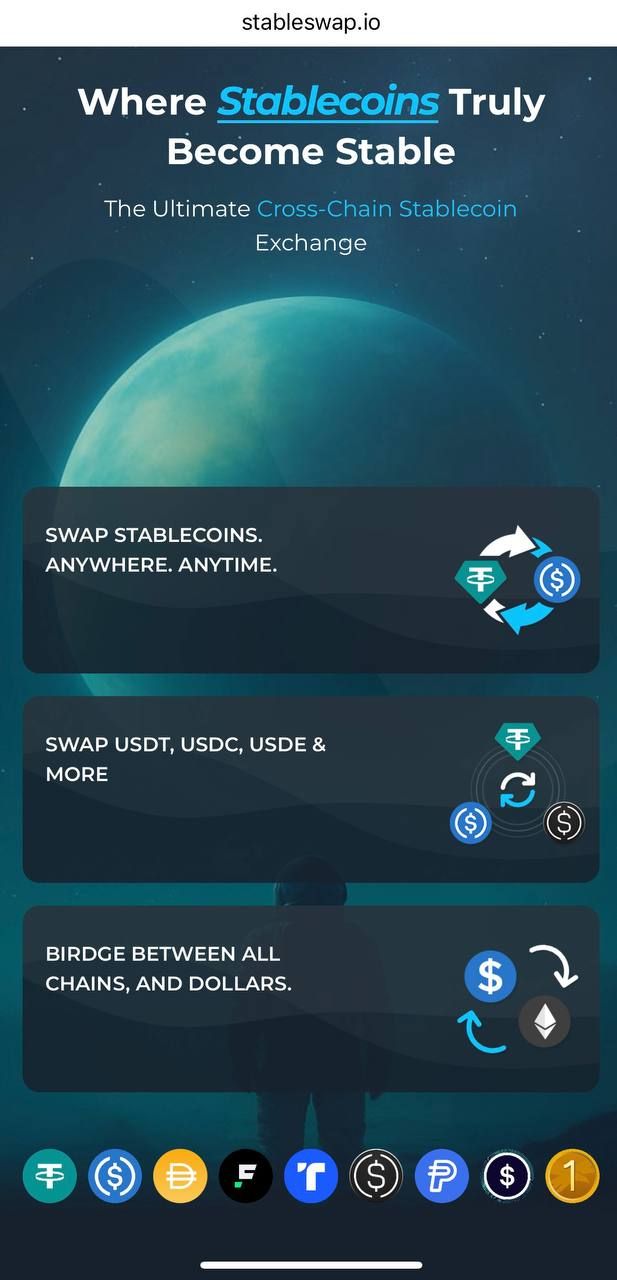
Liquidity fragmentation remains the primary friction point in multi-chain DeFi. Cross-chain StableSwap hubs address this by allowing liquidity to flow between disparate networks without forcing users to navigate complex bridge interfaces manually. These protocols act as centralized routing layers, aggregating depth from multiple chains to maintain tight spreads and low slippage.
LayerZero and Omnichain Integration
LayerZero’s omnichain infrastructure enables StableSwap implementations to operate seamlessly across Ethereum, Arbitrum, Optimism, and other EVM-compatible chains. By abstracting the underlying messaging protocols, these hubs allow a single pool to represent liquidity across multiple destinations. This reduces the capital inefficiency seen in isolated chain pools, where similar assets often suffer from thin order books.
StableChain and USD₮ Native Routing
StableChain represents a specialized approach by building a Layer 1 specifically optimized for USD₮ payments and StableSwap mechanics. Unlike generic bridges that merely move tokens, StableChain integrates the swap logic directly into the settlement layer. This design prioritizes predictable fees and instant finality, making it particularly effective for high-volume commercial payments where latency and cost volatility are significant risks.
Choosing the Right StableSwap Hub for 2026
Selecting a StableSwap hub in 2026 requires matching your specific asset class to the protocol’s underlying algorithm. Not all stablecoin pools are created equal; using a general-purpose AMM for pegged assets introduces unnecessary slippage. The decision framework rests on three concrete variables: the type of assets you are swapping, the blockchain network you prefer, and the regulatory environment of the protocol.
Evaluate Asset Correlation and Algorithm
The primary differentiator among StableSwap hubs is how they handle price stability. Curve Finance, for example, pioneered the StableSwap algorithm designed specifically for assets with similar values, such as USDC and USDT. This mechanism minimizes impermanent loss and keeps trading fees low for pegged coins. However, if you are trading volatile pairs or assets with different pegs, Curve’s Cryptoswap algorithm may be more appropriate. Always verify the algorithm type before depositing liquidity, as mismatched algorithms can lead to significant capital inefficiency.
Check Chain Compatibility and Gas Costs
Your choice of hub is often dictated by where your assets already reside. Ethereum remains the dominant chain for high-value stablecoin swaps due to its deep liquidity, but gas fees can erode profits for smaller transactions. Alternatives like Arbitrum, Optimism, or Polygon offer similar StableSwap implementations with a fraction of the cost. If you are a retail user making frequent small swaps, a Layer 2 hub is likely the better choice. For institutional-sized trades, the liquidity depth on Ethereum mainnet usually outweighs the gas premium.
Assess Regulatory Compliance and Custody
In 2026, regulatory scrutiny on DeFi protocols is intensifying. Some hubs have implemented on-chain compliance layers or restrict access based on jurisdiction. If you are operating a business or managing significant capital, ensure the hub you choose complies with relevant regulations in your region. Protocols that are fully decentralized and permissionless may offer higher yields but carry greater regulatory risk. Always review the protocol’s governance structure and any recent legal developments to avoid unexpected access restrictions.
No comments yet. Be the first to share your thoughts!